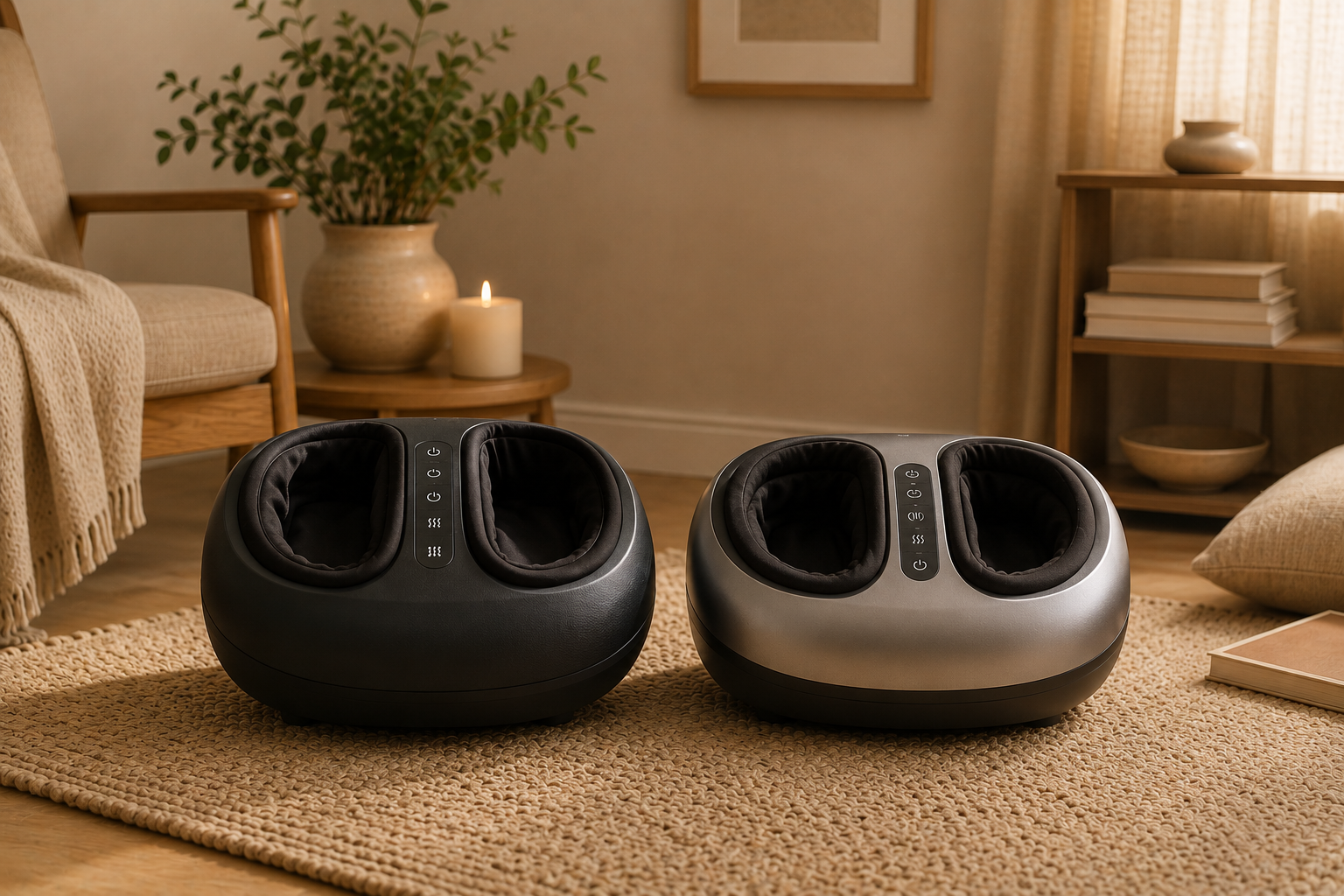
Nekteck vs RENPHO Foot Massager: Which Is Better for Plantar Fasciitis Relief?

Disclosure: As an Amazon Associate, I earn from qualifying purchases. This post contains affiliate links, which means we may receive a small commission at no extra cost to you, if you make a purchase through a link. This helps support our independent research and the maintenance of Lune & Ivory.

Plantar fasciitis can quietly get in the way of regular life, especially in tiny houses when comfort routines need to be simple, quick, and easy to put away. A foot massager can help, but not all of them are good for small spaces.

We looked at the specifications, user reviews, and real-world usage of the Nekteck Foot Massager and the RENPHO Foot Massager, which are two of the most popular choices. It’s not just a matter of which one gives a better massage; it’s also a matter of which one matches your space, your routine, and how much pain you’re in.

The Science What Causes Plantar Fasciitis Pain

It’s crucial to know how the pain works before you pick a tool. Plantar fasciitis is when the plantar fascia, a broad band of tissue that connects your heel bone to your toes and supports your arch, becomes inflamed.

The most well-known symptom is “first-step pain,” which is the intense, stabbing pain in the heel that happens as you get out of bed in the morning. The fascia tightens overnight, and the first few steps “force” the tissue to stretch, which makes micro-tears worse that were already there from standing on hard floors or doing the same thing over and over.

How Mechanical Massage Can Help

A dedicated foot massager has three main jobs in a rehabilitation system:

Getting rid of adhesions: Chronic inflammation can cause tiny regions of scar tissue (adhesions) to form over time. Targeted kneading helps break them up so that the tissue may move more freely.

The plantar fascia is part of a kinetic chain that connects the calf to the foot. When the calves are tight, they pull on the Achilles tendon, which pulls on the heel. Massagers that focus on the arch and heel let go of the tension at the bottom of this chain.

More blood flow: The fascia doesn’t get enough blood flow on its own, which hinders healing. Mechanical massage pushes blood into the area, which brings the oxygen and nutrients needed to heal micro-tears.

Quick Picks

Best Overall:

Best Budget:

Best Premium:

Best for Small Spaces:

Nekteck Foot Massager (The Minimalist Pick)

Positioning: A slim, open-top massager designed for daily use and easy storage. The Nekteck is a “plug-and-go” system, simple, lightweight, and designed for those who value low-friction routines.

Key Features

  • Open-top design with rotating Shiatsu nodes
  • Ultra-slim profile (~3.5 inches high)
  • Built-in heat function for circulation
  • Simple three-button control

Pros

  • Exceptionally space-efficient: It is one of the few massagers that can truly slide under a sofa or bed, making it ideal for studio apartments.
  • Manual Adjustability: Because the top is open, you can shift your foot to target your specific “trigger points” in the arch or heel.

Limitations

  • No air compression; it relies entirely on the pressure you apply by pushing your feet down.
  • May feel too light for those with severe, chronic fascia thickening.

Best For:

Small apartments, daily maintenance, and those who prefer a “breathable” massage experience.

Why It Stands Out

The open design is more than a space-saving feature, it changes how you use it. You can shift your foot forward, backward, or angle your heel directly onto the nodes. This makes it particularly helpful for targeting specific plantar fascia pain points without being locked into one position.

RENPHO Foot Massager (The Deep Tissue Pick)

Positioning: A high-intensity massager that is completely enclosed and meant to provide deep therapeutic relief.

The RENPHO is a “orb-style” massager that is more organized. It uses air compression to “grip” the foot, which makes it seem like a professional massage.

Important Features

  • Foot chambers with walls that keep pressure on all sides
  • Air compression technology that works like “squeezing”
  • Liners that may be taken out and washed for hygiene
  • Different levels of heat and intensity

Targeted Intensity: The air compression keeps your foot in place so the rollers may dig deeper into the plantar fascia. This is the best way to deal with severe heel pain.

Hygiene: The fact that the liners can be washed is a big plus for long-term use in a shared home.

Limitations

  • Bulky Profile: It needs a whole closet or a corner to fit; it won’t fit under normal furniture.
  • Intensity Curve: The lowest level could still be too harsh for people who are sensitive.

Best For:

People with severe plantar fasciitis, persistent pain, and a “wellness corner” in their house. 

Why It Stands Out

The defining feature here is air compression.

By locking your foot into position, the RENPHO ensures the rollers press deeply into the plantar fascia, something open designs can’t replicate. This makes it especially appealing for users seeking more aggressive pain relief.

Comparison Insights: What Actually Matters

Storage & Space Efficiency

  • Nekteck wins clearly. If your home already feels full, the Nekteck’s ability to “disappear” under a couch is its greatest feature.
  • RENPHO requires a plan. You will need to sacrifice a square foot of floor space or closet shelf to house this unit.

Intensity vs. Flexibility

  • RENPHO is the “Deep Fix.” If you need someone to dig into your heels until the pain subsides, choose the RENPHO.
  • Nekteck is the “Daily Maintenance.” It’s better for people who want to move their feet around and control the pressure themselves.

Lune & Ivory Pro-Tip:

In small homes, the best recovery tool is the one you don’t have to “fight” to use. If a device is too heavy to pull out of a closet, you won’t use it. If you have chronic pain, the RENPHO is worth the space. If you just need circulation, the Nekteck earns its place.

  • Choose Nekteck if you want a lightweight, space-saving solution for daily relief. It’s perfect for apartments and minimalist routines.
  • Choose RENPHO if you need deep, structured pressure and have the space to store a larger unit. It is the superior tool for persistent, chronic heel pain.

Recovery works best when your whole body is relaxed. Pair your foot massager routine with a calm sleep environment, our guides on Bedroom Humidity and [Silk Pillowcases] explore how to create a total sleep and recovery system.

Ease of Cleaning

  • Nekteck: Open surface = quick wipe-down
  • RENPHO: Removable liners = more thorough cleaning

RENPHO wins for hygiene, especially in shared households

How to Choose (Buyer’s Guide)

Choosing between these two comes down to a few practical realities.

1. Consider Your Space First

This is often overlooked.

If you don’t have a clear place to store a bulky device, you may stop using it altogether.

  • Choose Nekteck if space is limited
  • Choose RENPHO if you have a dedicated corner or closet

2. Understand Your Pain Level

  • Mild to moderateNekteck is often sufficient
  • Chronic or severeRENPHO’s compression is more effective

3. Think About Daily Use

Ask yourself: Will I use this every day?

  • Nekteck is easier to pull out quickly
  • RENPHO feels more like a planned session tool

4. Avoid Common Mistakes

  • Buying high intensity when you prefer gentle pressure
  • Ignoring storage constraints
  • Choosing features you won’t actually use

5. What Actually Matters

  • Consistency of use
  • Comfort level
  • Ease of integration into your routine

Frequently Asked Questions

1. Is a foot massager beneficial for those with plantar fasciitis?

Yes, a lot of people say they feel better once their circulation and muscles relax. But for it to work, you have to use it regularly and at the right amount of intensity.

2. Is it better to use air compression instead of only rollers?

Air compression gives you deeper, more regulated pressure, which can help with long-term pain. Rollers by themselves are more flexible but less intense.

3. Is it okay to use these massagers every day?

Most designs are meant to be used every day for 15 to 30 minutes at a time. Always do what the manufacturer says.

4. Which one is better for small apartments?

The Nekteck takes up a lot less space because of its compact, open form.

5. Do these take the place of stretching or physical therapy?

No. They function best when you do them as part of a bigger regimen that includes stretching, supportive shoes, and rest.

Kristina
We will be happy to hear your thoughts

Leave a reply

Lune and Ivory
Logo