Disclosure: As an Amazon Associate, I earn from qualifying purchases. This post contains affiliate links, which means we may receive a small commission, at no extra cost to you, if you make a purchase through a link. This helps support our independent research and the maintenance of Lune & Ivory.
There’s a quiet disconnect in most kitchen inspiration.
The spaces we save, perfectly styled, empty counters, untouched ceramics, rarely reflect how we actually live. When it comes to minimalist kitchen ideas for small spaces, “prettier” isn’t always “better.” Especially in a 10×10 kitchen, where every inch has to work twice as hard.
At Lune & Ivory, we approach kitchens differently. After reviewing real-life usage patterns and small-space constraints, one thing is clear: a kitchen should reduce friction, not add to it. This guide to minimalist kitchen ideas for small spaces is about creating a room that feels calm because it actually works.
Why Minimalist Kitchen Ideas Work in Small Spaces
Before we talk about layout, we need to talk about visual noise.
When your kitchen counters are crowded or mismatched, your brain reads that as “unfinished business.” Research in environmental psychology shows that cluttered spaces can increase cortisol levels, the same stress hormone triggered by deadlines. In a small kitchen, there is no visual buffer. No empty corner to “hide” the chaos.
Key Lune Principle: A calm kitchen reduces the mental cost of starting. When your space feels clear, your brain interprets cooking as a manageable joy rather than a daunting task.
Lune & Ivory Pro-Tip: Aim for at least 40% visible negative space on your counters. It doesn’t have to be empty, it just has to feel intentional.
The “Skinny” Appliance Rule
In small kitchens, space isn’t just limited, it’s directional. Most people think in terms of width, but the real opportunity lies in height and transformative storage.
The Logic: Why have three “roadblocks” on your counter (a toaster, an air fryer, and an oven) when you can have one? In a 10×10 space, horizontal real estate is your most valuable currency.
The Edit: Swap single-purpose gadgets for a Flip-Away Multi-Oven. This is the ultimate “Double Duty” win: it performs eight functions, but when you’re finished, it flips up against your backsplash. This reclaims 50% of your prep zone instantly.
- The “Lune” Take: This is the smartest investment for a functional kitchen. It replaces the “Visual Noise” of multiple gadgets with one unit that literally moves out of the way when you don’t need it. It’s the king of the Fast Reset.
Material Monotony: Creating Visual Quiet
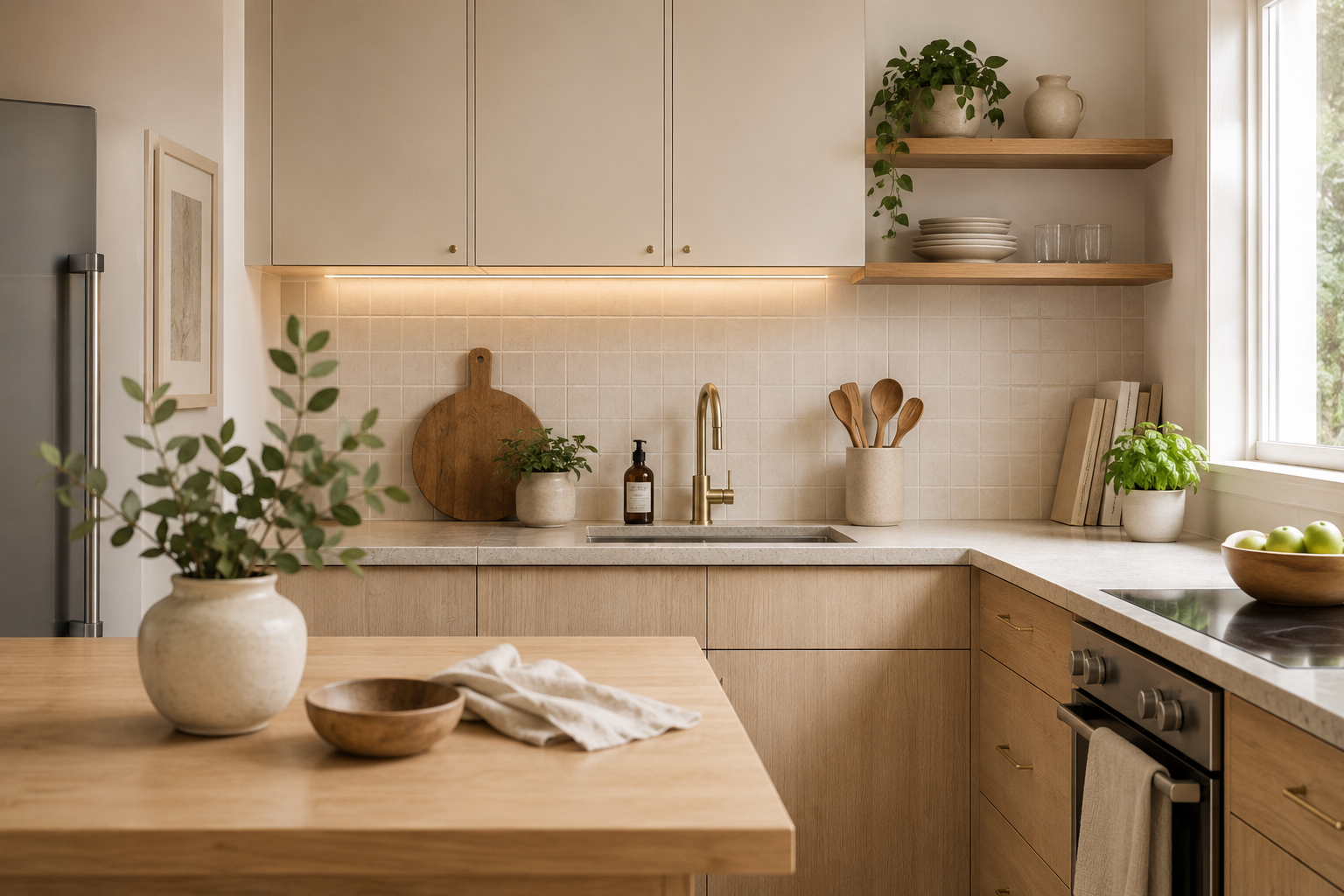
Minimalism isn’t just about having less; it’s about having less variation. One of the fastest ways to quiet a kitchen is through material consistency.
We call this Material Monotony. Instead of mixing multiple finishes (chrome, plastic, bright colors), anchor your kitchen in just two core materials, typically Matte Black and Natural Wood.
- The Strategy: In a small kitchen, we use wood to “bridge” gaps. A high-quality over-the-stove cutting board is the ultimate space-hacking tool. It hides dirty dishes, adds much-needed “Visual Quiet,” and literally doubles your counter space during prep. It can also be used over the sink as well so it is very versatile, you can decide where it goes, over the stove, over the sink or as a serving board.
[LASSO BOX: Bamboo Over-the-Stove Cutting Board]
- The “Lune” Take: This is the MVP of the 10×10 kitchen. It turns your sink into a functional extension of your countertop. It’s thick, durable, and provides that warm, organic texture that keeps a minimalist kitchen from feeling too sterile. With juice grooves and removable legs, it can be used over the stove, over the sink or as a serving board. An essential piece for the minimalist kitchen.
The “3-Object” Countertop Limit
This is our most transformative rule for maintaining a sense of calm. Limit your countertop to three intentional objects per functional zone.
The Logic: We don’t want empty, sterile counters, but we do want to avoid “Clutter Creep.” By defining a zone (like your coffee corner), you create a boundary.
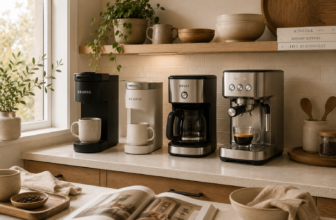
The Coffee Corner Example (The "Vertical Stack"):
- The Brew Station: A slim machine stacked on a wooden pod drawer (these count as one intentional object).
- The “Everyday” Mug: Your favorite ceramic piece.
- A Small Plant or Candle: To add a touch of “Warm” to the minimalism.
- The Edit: Instead of a sprawling espresso station, we utilize Verticality. By placing your brewer directly on top of a storage drawer, you hide the “Visual Noise” of colorful pods and reclaim every inch of horizontal space for food prep.
The “Lune” Take: This is the definition of “Everyday Minimalism.” It’s the smallest Vertuo machine ever made, it’s partially made from recycled materials, and the matte finish ensures it doesn’t shout for attention on your counter.
The “Lune” Take: This is the smallest Vertuo machine ever made. Its matte finish ensures it doesn’t shout for attention, and its 5-inch footprint is the gold standard for small-space living.
[LASSO BOX: Everie Wood Top Organizer for Vertuo Pods] Badge: SPACE ARCHITECT
- The “Lune” Take: This is the “pedestal” your machine deserves. It specifically fits the wider Vertuo pods and provides a sturdy wood surface that ties into our Material Monotony principle. It turns your coffee setup into a single, cohesive piece of Functional Art.
Unified Food Storage: Decant to De-Stress
Pantry chaos is the silent killer of kitchen calm. Grocery store packaging is designed to “shout” at you from the shelf with loud colors and mismatched shapes. To fix this, we Decant to De-stress.
Transferring dry goods into uniform containers yields three immediate wins:
- Visual Consistency: The “shouting” stops and the pantry recedes into the background.
- Verticality: Rectangular containers stack more efficiently than half-rolled bags of flour.
- Inventory Control: You see exactly when you’re low on staples at a glance.
The “Lune” Take: For the space-constrained 10×10 kitchen, these are the architectural answer to chaos. Their rectangular shape means zero “dead space,” and the crystal-clear, shatterproof finish gives you visual quiet without the weight of glass. It’s a pro-grade system at an accessible price.
The “Lune” Take: For the space-constrained 10×10 kitchen, these are the architectural answer to chaos. Their rectangular shape means zero “dead space” in your cabinets, and the crystal-clear, shatterproof finish gives you that visual quiet without the weight or fragility of glass. It’s a professional-grade organization system at an accessible price point.
The “Clear-to-Neutral” Habit Stack
A well-designed kitchen is a living system. The most important principle isn’t a product, it’s the nightly reset.
Each evening, aim to “Reset to Neutral”:
- Clear the sink.
- Wipe surfaces.
- Reset your “3-object” layout.
It takes less than 10 minutes, but you are protecting your future self’s energy. Walking into a neutral kitchen to start your Spa Morning ensures your brain stays in “calm mode” rather than jumping straight into “chore mode.”
Small-Space Systems That Work
In a 10×10 kitchen, storage is about accessibility. One of the most effective upgrades is organizing drawers so you can find a whisk in three seconds, not thirty.
Drawer systems reduce the need for countertop storage, keeping your space visually clear while making everyday tools easier to reach.
Frequently Asked Questions
1. How do I handle the "Junk Drawer"?
Empty it. Reintroduce only what you use weekly. Everything else is either “Utility” (relocate to a toolbox) or “Trash.”
2. Is decanting worth the time?
Only for staples (coffee, pasta, flour). Don’t waste time decanting ingredients you use once a month.
3. What is the first thing I should change?
Clear your counters today. Reducing visible clutter provides an immediate hit of dopamine and builds momentum for the rest of the kitchen.
Minimalism, when done right, doesn’t restrict your life; it quietly supports it. A kitchen that looks good but feels hard to use won’t last. A kitchen that supports your routine will.