Best Humidifiers for a Small Bedroom (Quiet Enough to Sleep With)

Disclosure: As an Amazon Associate, I earn from qualifying purchases. This post contains affiliate links, which means we may receive a small commission, at no extra cost to you, if you make a purchase through a link. This helps support our independent research and the maintenance of Lune & Ivory.

Somewhere around week two of dry winter air, most people cave and buy a humidifier. And then, somewhere around night three of owning it, they realize the actual problem: it hums. Loudly enough that falling asleep now competes with a low mechanical whir coming from three feet away.

A humidifier that keeps you up defeats its own purpose. If you’re adding one to a small bedroom, noise isn’t a secondary spec, it’s the single most important factor, right alongside whether the thing looks like a piece of medical equipment sitting on your nightstand next to your books and your lamp.

This is our guide to the best humidifiers for a small bedroom, chosen specifically for quiet overnight operation, a footprint that makes sense in a compact room, and a look that doesn’t fight your décor.

Key Takeaways

  • Noise matters more in a bedroom than almost any other humidifier spec — look for models under 30–35 decibels on their lowest setting
  • Small bedrooms (under 300 sq ft) generally don’t need a large-capacity unit; oversized humidifiers risk over-humidifying a small room
  • Cool mist is the safer, more common choice for bedrooms, especially with kids or pets nearby
  • A humidistat (automatic shut-off at a set humidity level) prevents mold risk from over-humidifying — worth prioritizing over a lower price
  • Filterless ultrasonic models are quieter but need more frequent cleaning to avoid mineral buildup and bacteria
  • Match the color and shape to your nightstand setup; a humidifier is one of your “3 objects” if it lives there permanently

Why Bedroom Humidifiers Need Different Criteria Than Living Room Ones

Every general “best humidifier” list is written for living rooms and open-plan spaces, where coverage area and features matter most. A bedroom humidifier answers to a different set of priorities entirely: it needs to run all night without disturbing sleep; it needs to fit a room typically under 200–300 square feet without overwhelming it; and, because it’s sitting a few feet from your face for eight hours, it needs a design that doesn’t clash with everything else on your nightstand.

Independent testing consistently shows that humidifier size and tank capacity aren’t reliable predictors of noise level or how well-suited a unit is to a small room. Some of the largest 6-liter tabletop humidifiers are actually quieter than smaller units, and a humidifier that’s rated for a 500-square-foot living room will very likely over-humidify a 120-square-foot bedroom if left unchecked.

The Best Humidifiers for a Small Bedroom

1. Levoit Dual 150

Best compact pick for very small bedrooms

[LASSO BOX: Levoit Dual 150 Humidifier]

Small bedrooms and dorm-sized rooms are precisely what this unit was built for. Its compact footprint fits comfortably on a nightstand without dominating it, and, unlike many humidifiers this size, it doubles as an essential oil diffuser, which pairs naturally if you’re already building a scent-based bedtime ritual. The tradeoff for its small size is a smaller tank, so expect to refill more often than a full-size unit, and it’s rated for smaller rooms rather than open-plan spaces.

Pros: Genuinely small footprint, doubles as a diffuser, easy to place on a nightstand
Limitations: Smaller tank means more frequent refills, underpowered for rooms over 300 sq ft

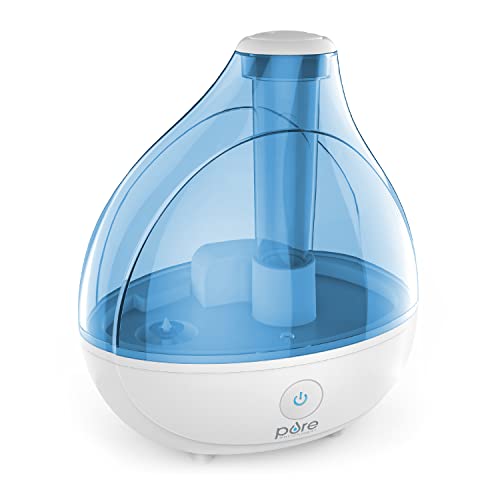
2. Pure Enrichment MistAire Ultrasonic Cool Mist Humidifier

Best for hot sleepers

[LASSO BOX: Pure Enrichment MistAire Ultrasonic Cool Mist Humidifier]

If you run warm at night, a cool mist humidifier is the better fit, it adds moisture without adding heat to the room, unlike warm-mist models. This one has consistently tested well for quiet, reliable overnight operation and a simple, unfussy design that doesn’t try too hard visually, which actually works in its favor: it recedes rather than demands attention.

Pros: Cool mist keeps the room from feeling warmer; tested quiet, straightforward and unobtrusive design
Limitations: Fewer smart features than premium options, basic mist controls

3. Vitruvi Cloud Humidifier

Best design-forward pick for warm-minimalist bedrooms

[LASSO BOX: Vitruvi Cloud Humidifier]

If you already know and love Vitruvi’s ceramic diffuser aesthetic, their humidifier follows the same design language, filterless, minimal, and genuinely built to sit out as a decor object rather than be tucked away. It’s rated to cover up to 600 square feet, which is more capacity than most small bedrooms need, so you’ll likely run it on a lower setting most nights. The filterless design means less ongoing cost, but the water reservoir still needs regular cleaning to avoid mineral buildup.

Pros: Genuinely beautiful, filterless (no ongoing filter cost), dishwasher-safe reservoir, excellent build quality
Limitations: Premium price point, oversized capacity for a small room means running it on low most of the time

4. Babymoov Hygro+

Best for precise small-room humidity control

[LASSO BOX: Babymoov Hygro+ Humidifier]

Originally designed for nurseries, which means it was built from the ground up for small rooms and quiet overnight operation, both priorities align perfectly with a small bedroom’s needs. It’s specifically sized for rooms up to roughly 215 square feet, which is a more honest capacity claim than many “small room” humidifiers that are secretly rated for much larger spaces.

Pros: Built specifically for small-room precision, easy to use, reliable auto-shutoff
Limitations: Not designed for rooms larger than about 215 sq ft; simpler feature set than premium options

5. Dreo Compact Humidifier (3L)

Best value pick

[LASSO BOX: Dreo 3L Compact Humidifier]

A dependable mid-range option if you want smart features (app control, scheduling) without paying premium prices. Independent testing found it delivers strong performance on low settings specifically, a useful trait for bedroom use, where you’ll rarely want it running at full blast overnight.

Pros: Smart app features at a mid-range price, strong low-setting performance, roughly 3-liter tank balances runtime and footprint
Limitations: Smaller capacity than some rivals at a similar price, plainer design than the Vitruvi

What Actually Matters for a Bedroom Humidifier

  • Noise level. Look specifically for a stated decibel rating on the lowest setting, ideally under 30–35 dB, that’s roughly the level of rustling leaves. Reviews that mention “you can hear it” on low settings are a clear warning for bedroom use.
  • Room size accuracy. Don’t oversize. A humidifier rated for 500+ square feet will often over-humidify a small bedroom faster than you can notice, which creates ideal conditions for mold and dust mites. Match the rated coverage to your actual room size, erring toward smaller if your bedroom is under 200 square feet.
  • Auto shut-off / humidistat. A built-in humidity sensor that stops the unit once the room reaches a healthy level (ideally 30–50% relative humidity, per EPA and ASHRAE guidance) removes the guesswork and the overnight risk of over-humidifying while you sleep.
  • Cool mist vs. warm mist. Cool mist is the safer, more common choice for bedrooms, no burn risk, no added heat. Warm mist units aren’t recommended if anyone in the household has a cold, since warm moisture can actually worsen nasal swelling.
  • Cleaning requirements. Filterless ultrasonic units are quieter and cheaper to run long-term but need more frequent manual cleaning to prevent mineral dust and bacteria buildup. Factor in your actual willingness to clean weekly before choosing a filterless model.

Styling a Humidifier Into a Small Bedroom

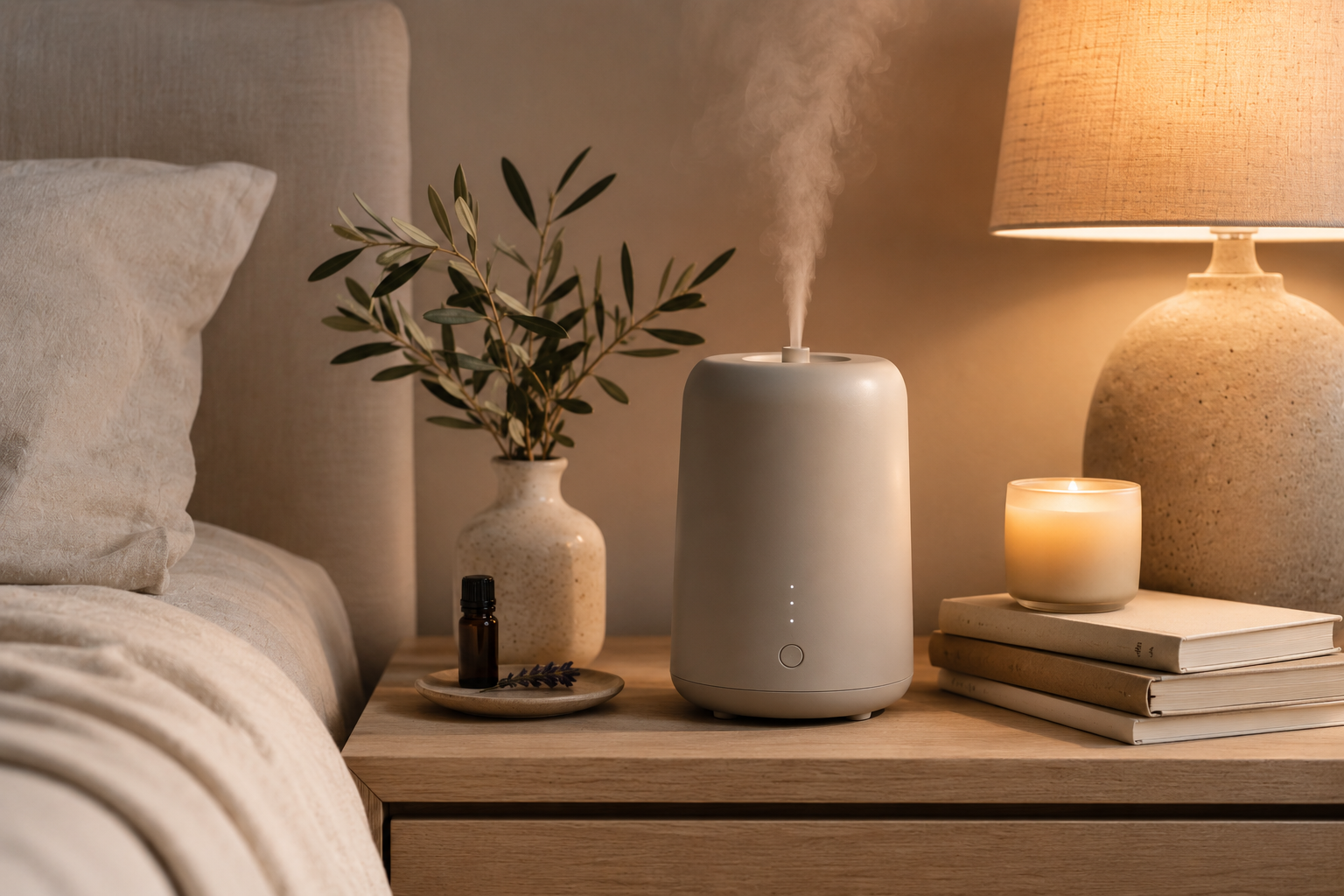
A humidifier that lives permanently on your nightstand counts as one of your three visible objects under our 3-Object Rule, which means it needs to earn that spot the same way a lamp or a candle would.

Ceramic and matte-finish humidifiers (like the Vitruvi Cloud) blend naturally into a warm-minimalist palette. If you’re using a more utilitarian plastic model, consider positioning it slightly behind or beside a taller object, a stack of books, a small plant, so it reads as part of a grouped vignette rather than a standalone appliance.

Humidity also interacts directly with other bedroom decor choices. If you already own a Himalayan salt lamp, running a humidifier nearby will likely increase how often it sweats, worth knowing before you add both to the same small room. And if you’re deciding between a humidifier and a diffuser for your evening ritual, our Vitruvi vs Pura comparison covers the tradeoffs between water-based and waterless systems in more depth.

Frequently Asked Questions

1. What is the best humidifier for a small bedroom?

For most small bedrooms, a compact, quiet-rated unit like the Levoit Dual 150 or Babymoov Hygro+ is the best fit, both are sized specifically for smaller rooms rather than open-plan spaces, which prevents over-humidifying while you sleep.

2. How loud is too loud for a bedroom humidifier?

Look for a stated decibel rating under 30–35 dB on the lowest setting. Anything you can clearly hear from bed is likely to disrupt sleep over time, even if it doesn’t fully wake you.

3. Is cool mist or warm mist better for a bedroom?

Cool mist is generally the safer and more common choice for bedrooms, no burn risk, and it won’t add heat to the room. Warm mist should be avoided if anyone using the room has a cold, since it can worsen nasal congestion.

4. Can a humidifier be too big for a small bedroom?

Yes. A humidifier rated for a much larger space than your bedroom can over-humidify the room faster than expected, creating conditions for mold and dust mites. Match the humidifier’s rated coverage to your actual room size.

5. How do I know if my bedroom needs a humidifier?

Common signs include waking up with a dry throat, nose, or itchy skin, especially during winter or in dry climates. A basic hygrometer (humidity meter) can confirm whether your room’s humidity is below the recommended 30–50% range.

6. How often should I clean my bedroom humidifier?

Most manufacturers recommend cleaning weekly, and always emptying and drying the tank between uses if it will sit unused for more than a day. Filterless ultrasonic models need more frequent cleaning than filtered ones to prevent mineral buildup and bacteria growth.

A humidifier is one of the few appliances that works best when you forget it’s there, quietly maintaining a comfortable room while you sleep, not asking for attention through noise or an awkward, out-of-place design. Choose one built for a small room specifically, and it should do exactly that.

Elle
We will be happy to hear your thoughts

Leave a reply

Lune and Ivory
Logo