How to Layer Rugs in a Small Room (Without It Looking Busy)
 Kristina
Disclosure: As an Amazon Associate, I earn from qualifying purchases. This post contains affiliate links, which means we may receive a small commission, at no extra cost to you, if you make a purchase through a link. This helps support our independent research and the maintenance of Lune & Ivory.
Rug layering has a reputation problem in small rooms. Done badly, it looks like two rugs got into an argument on your living room floor, competing patterns, clashing colors, and a floor that reads as busier than the rest of the room combined. Done well, it’s one of the most effective ways to add depth, warmth, and visual interest to a compact space without adding a single extra piece of furniture.
The difference almost always comes down to three things: size ratio, color connection, and restraint. Get those right, and layered rugs read as intentional and considered. Get them wrong, and even a beautiful individual rug ends up contributing to clutter instead of calm.
This is a practical guide to layering rugs specifically in a small room, where the margin for error is smaller and every choice is more visible than it would be in a larger space.
Key Takeaways
- The top rug should cover roughly 60 to 70% of the base rug, leaving a visible border on all sides, that border is what makes the layering read as intentional
- Connect the two rugs through at least one shared color, even if their patterns and textures are completely different
- In a genuinely small room, one well-sized rug can outperform two layered ones, layering isn’t always the right call, and that’s worth knowing before you commit
- Natural fiber bases (jute, sisal, flatweave) pair well with almost anything layered on top and add the least visual bulk
- Always use a rug pad between layers to prevent slipping, bunching, and premature wear
- Lighter, monochromatic color pairings tend to keep small rooms feeling open; heavy contrast works better in larger spaces
The Size Ratio That Actually Makes Layering Work
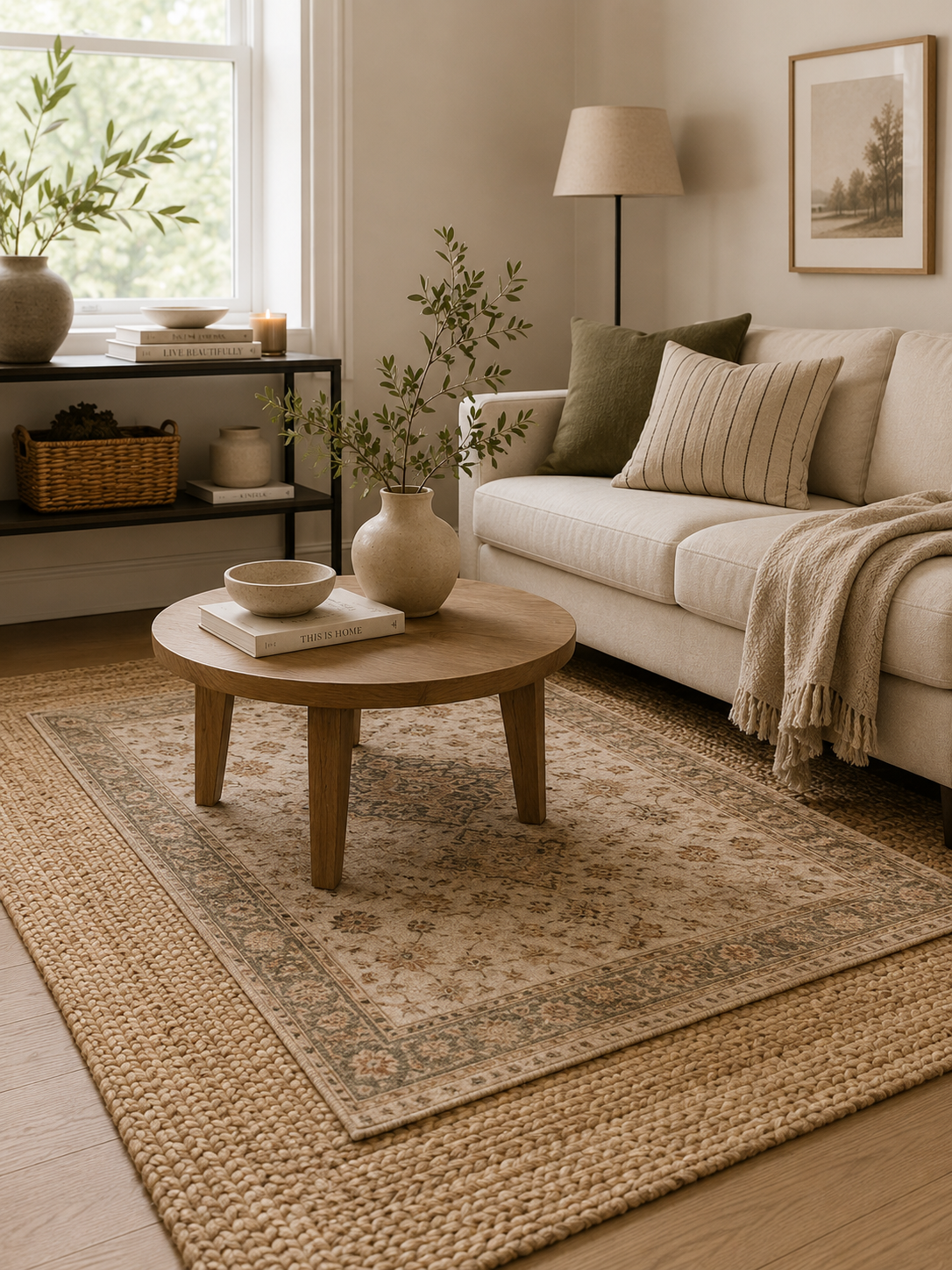
The single most important rule in rug layering, confirmed consistently across nearly every professional source on the subject, is proportion: your top rug should cover approximately 60 to 70% of your base rug’s surface area, leaving the base rug’s edges visible as a border all the way around.
That visible border is doing more work than it looks like. It’s what separates “two rugs, clearly layered on purpose” from “a smaller rug randomly placed on top of a bigger one.” Without it, the eye can’t tell where one rug ends and the next begins, and the whole thing reads as accidental rather than styled.
In a small room specifically, this ratio matters even more, because there’s less floor space to establish the pattern visually. A base rug that’s only slightly larger than the top layer won’t leave enough border to register clearly, and the layering effect disappears entirely.
The Color Rule That Ties It All Together
Patterns can differ. Textures can differ. Even shapes can differ. But your two rugs need at least one shared color connecting them, or the pairing will feel disjointed no matter how carefully you get the size ratio right.
This doesn’t mean matching exactly, a neutral, natural-toned base rug paired with a boldly patterned top layer works precisely because the top rug’s color palette pulls from tones already present in the base. Think of the base rug as the anchor and the top rug as the accent; the accent should always reference the anchor’s palette somewhere, even if it’s just one thread color in an otherwise busy pattern.
For a small room, sticking to a tighter color relationship, a monochromatic or tonal pairing rather than high contrast, is generally the safer choice. High-contrast layering (a stark white base with a jet black patterned top, for example) reads as bold and graphic, which can work beautifully in a larger room but risks visually shrinking a small one.
When Layering Isn't Actually the Right Move
Here’s something most rug-layering guides skip entirely: in a genuinely small room, a single, well-sized rug sometimes outperforms two layered ones. Design experts specifically flag this, in compact spaces, multiple smaller rugs can fragment the room and make it feel busier rather than more considered, whereas one larger rug, sized correctly for the space, does more to make the room feel calm and cohesive.
The honest test is this: if your small room already has a lot of visual information happening (patterned furniture, busy wall art, a lot of visible storage), a single, quiet rug is usually the better call. Layering earns its place specifically when the rest of the room is calm enough to support the added visual layer without tipping into clutter, which ties directly into the same “visual budget” logic behind our 3-Object Rule.
The Best Material Pairings for a Small Room
1. Flatweave or jute base + a smaller patterned rug on top
This is the most forgiving combination for a small space, since a flatweave or natural fiber base adds almost no bulk underfoot and won’t create a tripping hazard near doorways, an important consideration in a compact room where floor clearance is already tight.
[LASSO BOX: Natural Jute or Sisal Flatweave Area Rug]
2. A kilim or lightly patterned rug as the top layer
Kilims add color and detail without much added thickness, which matters if your base rug is already sitting close to a doorway threshold or furniture leg.
[LASSO BOX: Kilim-Style Patterned Accent Rug]
3. A low-pile vintage-style rug over a tight-weave neutral base
This pairing adds visual richness and a sense of history to a room without the bulk of a true shag layer, which can feel overwhelming underfoot in a small space.
[LASSO BOX: Low-Pile Vintage-Style Distressed Rug]
Avoid pairing two thick, high-pile rugs together in a small room. The combined bulk creates an uneven, unstable surface underfoot and can make a compact space feel more cramped rather than more layered.
Where to Position Layered Rugs in a Small Room
- Under a coffee table. The top rug should sit centered under the table, with the front legs of your seating resting near or just on its edge, this visually anchors the layering to the room’s main gathering point rather than leaving it looking like a random accent.
- In a reading corner or small nook. Layering works especially well here, since it visually defines a smaller zone within an already-small room without needing a physical divider or extra furniture.
- Near an entryway. A layered rug combination at an entry can absorb foot traffic on the tougher, more affordable base layer while the more delicate or decorative top rug lives just beyond the highest-wear zone.
Whatever the placement, always add a rug pad between the two layers. This prevents slipping, keeps the top rug from bunching or sliding out of position over time, and reduces wear on both rugs from friction against each other.
[LASSO BOX: Non-Slip Rug Pad, cut-to-size]
Frequently Asked Questions
1. What size should the top rug be compared to the base rug?
The top rug should cover roughly 60 to 70% of the base rug’s surface, leaving a visible border of the base rug on all sides. This ratio is what makes the layering look intentional rather than accidental.
2. Do layered rugs need to match in color?
Not exactly, but they should share at least one connecting color. A neutral base with a patterned top works well as long as the top rug’s palette references tones already present in the base rug.
3. Is rug layering a good idea in a small room, or does it make the space feel busier?
It depends on the rest of the room. If your small room already has a lot of pattern or visual clutter, a single well-sized rug is usually the better choice. Layering works best when the surrounding space is calm enough to support the added visual interest.
4. What rug materials work best for layering in a small space?
Flatweave, jute, and sisal bases add the least bulk and work well under almost any patterned top layer. Avoid pairing two thick, high-pile rugs together, since the combined bulk can feel unstable and visually heavy in a compact room.
5. Do I need a rug pad between layered rugs?
Yes. A rug pad prevents slipping and bunching between the two layers, reduces wear from friction, and keeps the top rug from sliding out of its intended position over time.
6. Can I layer rugs of different shapes?
Yes. a round top rug over a rectangular base, for example, can work well, particularly under a round coffee table or in a reading nook. Shape contrast can actually help define the layering more clearly than two rugs of the same shape.
A well-layered rug pairing should feel like it was always meant to be there, not like an extra decision competing for attention with everything else in the room. Get the size ratio and color connection right, and a small room gains real depth without losing an inch of its calm.