
Disclosure: As an Amazon Associate, I earn from qualifying purchases. This post contains affiliate links, which means we may receive a small commission, at no extra cost to you, if you make a purchase through a link. This helps support our independent research and the maintenance of Lune & Ivory.
Most decluttering advice asks you to make a binary decision about every object you own: keep it or get rid of it. That works fine for the obvious cases, the broken thing, the duplicate, the item you forgot you had. It falls apart the moment you’re holding something you genuinely aren’t sure about, which is most of what actually lives in a cluttered drawer or closet.
Professional organizers have been recommending a gentler alternative: sorting your belongings into three categories based on how you actually relate to them, not just whether you use them. It’s called the Strangers, Acquaintances, and Friends method, and it works because it makes room for the middle ground that most decluttering rules ignore entirely.
This is a room-by-room guide to applying it, plus the sorting tools that make the process easier than doing it with three piles on the floor.
Key Takeaways
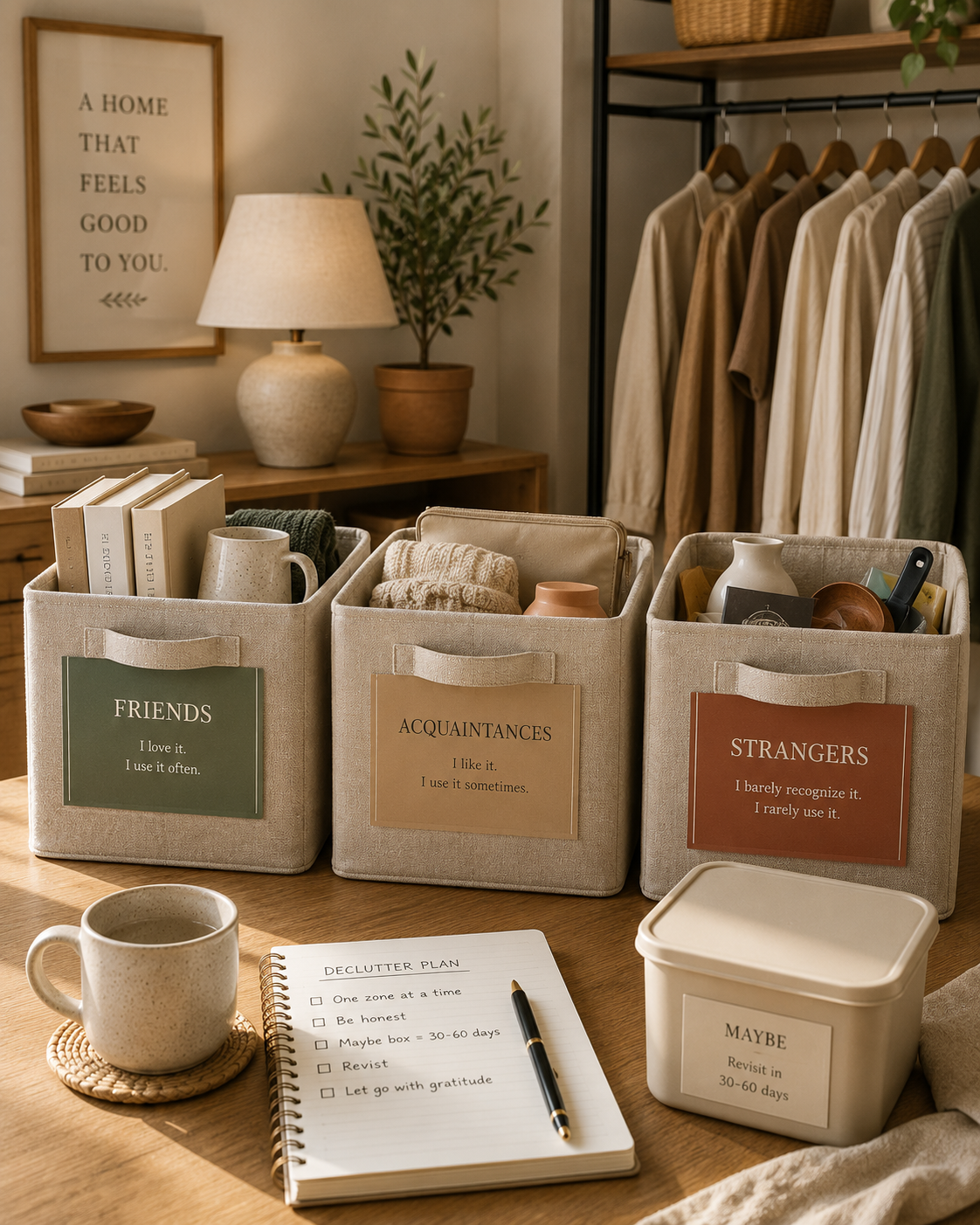
- The method sorts belongings into three categories: Friends (love it, use it often), Acquaintances (like it, use it occasionally), and Strangers (barely recognize it, rarely touch it)
- Friends stay and get a proper, designated home. Strangers get donated, recycled, or passed on. Acquaintances go into a “maybe” box
- Revisit the “maybe” box in 30 to 60 days, if you haven’t reached for anything inside, the decision becomes obvious
- Work in small, contained zones (one drawer, one shelf) rather than an entire room at once
- The method works especially well for clothing, books, paperwork, kitchen drawers, and sentimental items, anywhere decisions feel emotionally loaded
- You don’t need an entire weekend for this; a few focused minutes at a time adds up
What the Strangers, Acquaintances, Friends Method Actually Is
The method comes from professional organizing circles, most notably explained by organizer Jessica Linighan of Homefulness, who describes it as “a thoughtful, emotionally informed way to declutter” designed specifically for people who feel overwhelmed by constant either-or decisions.
The three categories work like this:
- Friends are the items you genuinely love, use often, and would replace immediately if they broke or went missing.
- Acquaintances are items you like well enough but don’t feel strongly about, things you might use, occasionally do use, but wouldn’t think twice about if they disappeared.
- Strangers are the items you barely recognize anymore. Things you’ve outgrown, forgotten you owned, or haven’t touched in longer than you can remember.
The insight behind this framework is that sorting by emotional connection, rather than by a strict use-it-or-lose-it rule, takes the guilt out of the process. You’re not being asked to justify keeping something, you’re being asked to honestly name what kind of relationship you actually have with it.
How to Apply the Method, Room by Room
1. Start With a Micro-Zone, Not a Whole Room
The method works best applied to a small, contained area, a single drawer, one shelf, or one section of a closet, rather than an entire room in one sitting. This mirrors the same logic behind our 3-Object Rule: smaller, contained decisions are genuinely easier to make well than sweeping overhauls, and they don’t require blocking out an entire weekend.
2. Pick Up One Item and Ask the Question
Handle each object individually and ask: is this a Friend, an Acquaintance, or a Stranger? Friends get put back with a proper, designated spot. Strangers go straight into a donate, recycle, or pass-along pile. Anything that falls into the Acquaintance category goes into a separate box.
[LASSO BOX: Canvas Sorting Bins, Set of 3, labeled Keep / Donate / Maybe]
3. Give the "Acquaintance" Box a Set Revisit Date
This is the step that makes the method sustainable rather than just another system that gets abandoned halfway through. Items you’re unsure about go into a labeled transition box for 30 to 60 days. If you haven’t needed or reached for anything in that box by the time you revisit it, the decision becomes obvious, donate without further deliberation.
[LASSO BOX: Labeled Storage Bin with Lid, for “Maybe” transition items]
4. Apply It to the Kitchen First
Kitchen drawers are one of the easiest places to start, since duplicate tools, mismatched containers, and single-use gadgets tend to sort themselves quickly once you’re holding them one at a time. A junk drawer that’s accumulated for years usually reveals its Strangers almost immediately, the promotional bottle opener, the takeout menu magnets, the gadget you bought for one recipe three years ago.
5. Move to Closets and Clothing
Clothing is one of the categories professional organizers specifically flag as well-suited to this method, since clothes carry more emotional weight than most objects. An item you haven’t worn in a year but still love the idea of is a genuine Acquaintance, not an automatic Stranger, the method gives you permission to hold onto a few of those without guilt, as long as they go into the reviewed “maybe” category rather than living indefinitely on a hanger you never touch.
6. Save Sentimental Items and Paperwork for Last
Sentimental belongings and old paperwork are where decisions feel heaviest, and organizers recommend approaching these last, once you’ve had practice with lower-stakes categories. A practical tip that helps: photograph a sentimental object or write a short note about why it mattered before letting it go. The memory stays intact without the physical clutter staying with it.
7. Where to Store Each Category While You Sort
Having a physical system ready before you start prevents the whole process from turning into three piles scattered across the floor.
For Friends, a proper, designated home means actual storage, labeled bins for a closet, drawer organizers for a kitchen, a dedicated shelf for books you’re keeping. This is also a good moment to apply the Texture Rule if any of these items will be visible: natural materials like canvas and wood read as intentional storage rather than clutter.
[LASSO BOX: Adjustable Drawer Dividers, bamboo or acrylic]
For Strangers, a donation box or bag kept by the door (not tucked away in a closet where it’s easy to forget) keeps momentum going. Items sitting in a donation pile for weeks because the bag never made it to the car defeats the purpose.
[LASSO BOX: Collapsible Donation Tote, for easy transport]
For Acquaintances, a single labeled bin with a visible date written on it is enough. The date matters more than the container, it’s what turns “maybe someday” into an actual decision point.
Why This Method Works Better Than an All-or-Nothing Approach
Most decluttering frustration comes from being forced into a binary decision on something that genuinely sits in the middle. A rule like “if you haven’t used it in six months, get rid of it” doesn’t account for the coat you wear once a winter, or the serving dish that only comes out for the holidays, both would fail a strict use-it-or-lose-it test while still being objects you’d genuinely miss.
The Strangers, Acquaintances, Friends method solves this by giving the “maybe” category a legitimate, time-bound place to exist, rather than forcing an immediate verdict. This is the same underlying philosophy behind our own Would I Miss This? method, both approaches recognize that a calm, intentional home doesn’t require owning as little as physically possible. It requires being honest about what you actually value, and giving yourself a structured way to figure that out without decision fatigue setting in halfway through a drawer.
Common Mistakes to Avoid
Trying to sort an entire room at once. This method is built around micro-zones specifically because whole-room decluttering leads to fatigue and half-finished piles. Stick to one drawer or shelf per session.
Letting the “maybe” box become permanent. Without a revisit date, a transition box just becomes a new, quieter form of clutter. Write the date on it and put it somewhere you’ll actually see it again.
Starting with sentimental items. These carry the most emotional weight and are the hardest to practice on. Build confidence with kitchen drawers or closets first.
Skipping the “proper home” step for Friends. An item you’ve confirmed you love but never actually put back in a designated spot will just end up cluttering a surface again. Decluttering isn’t finished until the keepers have a real home, not just a temporary landing spot.
Frequently Asked Questions
1. What is the Strangers, Acquaintances, Friends decluttering method?
It’s a decluttering technique that sorts belongings into three categories based on emotional connection and actual use: Friends (loved, used often), Acquaintances (liked, used occasionally), and Strangers (barely recognized, rarely used). It was popularized by professional organizers as a gentler alternative to strict keep-or-toss rules.
2. How long should I keep items in the "Acquaintance" or maybe box?
Most organizers recommend 30 to 60 days. If you haven’t needed anything inside the box during that period, donating the contents becomes a much easier decision.
3. Does this method work for sentimental items?
Yes, though organizers suggest saving these for last, once you’ve had practice sorting lower-stakes categories. Photographing a sentimental object or writing down why it mattered can help you let go of the physical item without losing the memory.
4. How is this different from other decluttering methods?
Most decluttering rules ask a binary question, keep or discard. This method specifically creates a legitimate middle category for items you’re genuinely unsure about, which reduces the guilt and decision fatigue that often causes decluttering attempts to stall out.
5. Do I need to declutter an entire room in one session?
No, the method is specifically designed around small, contained zones like a single drawer or shelf. Organizers note that a few focused minutes at a time can transform an entire space over weeks, without requiring a full weekend commitment.
6. What rooms work best for this method?
Kitchen drawers, clothing and closets, books, and paperwork are commonly cited as strong starting points, since decisions tend to be less emotionally loaded than with sentimental keepsakes.
A calm home doesn’t come from eliminating everything you own. It comes from being honest about what you’d actually miss, and giving yourself permission to sit with the things you’re not sure about, instead of forcing a decision before you’re ready.