
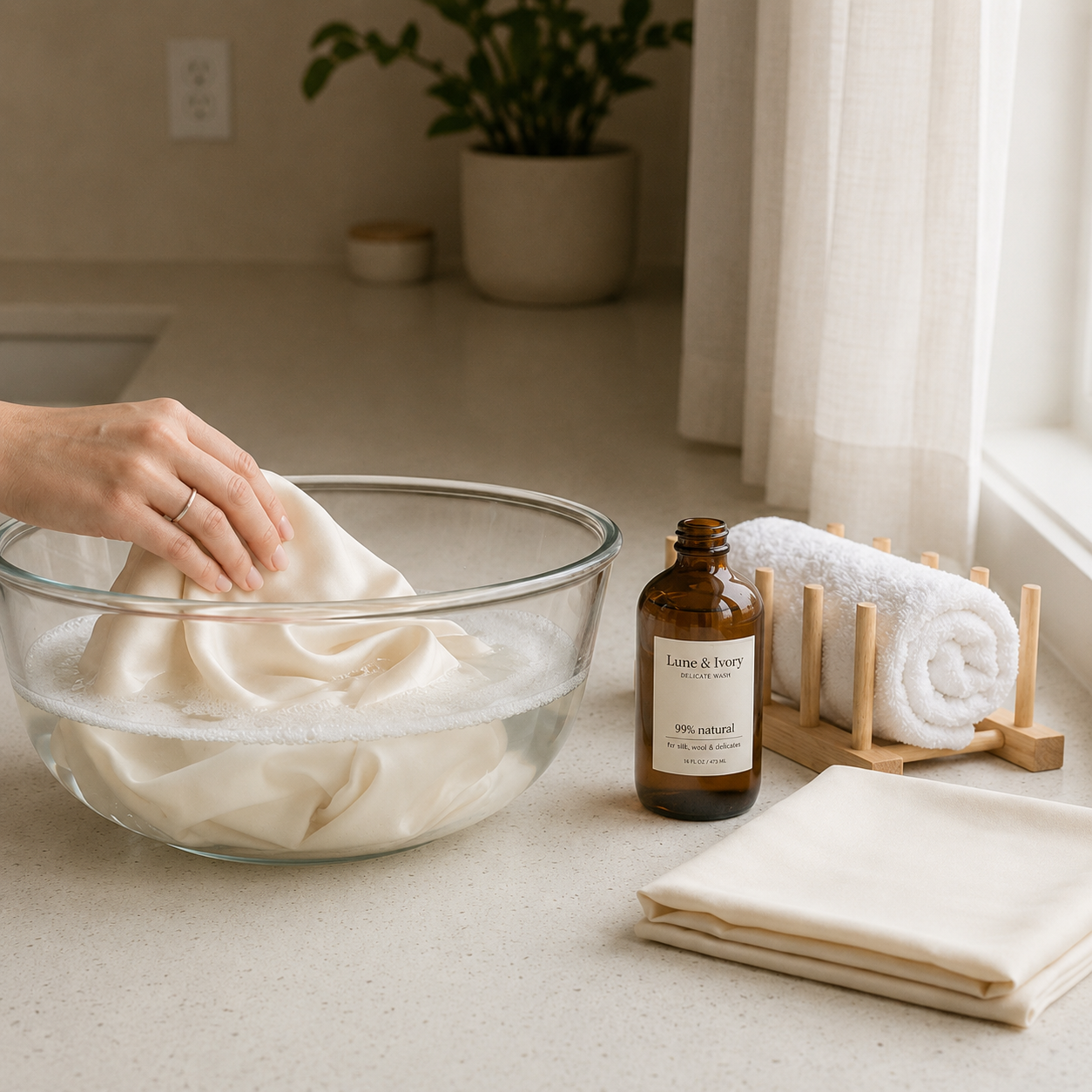
How to Clean a Silk Pillowcase Without a Laundry Room: The Ultimate Care System

Disclosure: As an Amazon Associate, I earn from qualifying purchases. This post contains affiliate links, which means we may receive a small commission at no extra cost to you, if you make a purchase through a link. This helps support our independent research and the maintenance of Lune & Ivory.

There is a specific kind of anxiety that comes with buying a $90 25-momme silk pillowcase, only to realize your apartment’s communal laundry room is a graveyard for delicate fibers. Most of us have been there: standing over a high-efficiency agitator, wondering if the “delicate cycle” is a promise or a lie.

In a Warm Minimalism home, we prioritize quality over quantity. But quality requires a different kind of labor, intentional care.

If you’re living in a small space without a dedicated laundry room, washing silk doesn’t have to be a multi-day ordeal involving drying racks draped over your dining chairs. This is the Lune & Ivory Silk Care System: a 10-minute ritual that preserves the protein fibers of your silk, restores its luster, and fits perfectly into the footprint of a 10×10 bedroom.

[LASSO PLACEHOLDER: Heritage Park Silk & Wool Wash]

Why "Machine Washable" Silk is Often a Myth

You’ll see many brands (even the ones we love) claim their silk is “machine washable.” While technically true, there is a massive difference between surviving a wash and thriving after one.

Silk is a natural protein fiber, much like your hair. Standard laundry detergents are alkaline and often contain protease enzymes. These enzymes are designed to “eat” protein-based stains like grass or blood. The problem? They can’t tell the difference between a blood stain and your silk pillowcase. Over time, these detergents literally digest the fibers, leading to:

  • The “Crunch”: That stiff, paper-like texture.
  • The Dullness: Loss of the “pearl” sheen.
  • The Shred: Micro-tears that lead to fraying.

In a small bedroom, where your bed is the visual centerpiece, a dull, wrinkled pillowcase breaks the “Warm Minimalism” vibe. Hand-washing is the only way to ensure your investment looks as good in 2026 as it did on day one.

The "Invisible Laundry" Kit

To clean silk in a small space, you need a compact kit that lives under your bathroom sink.

1. The pH-Neutral Detergent

Forget Woolite or standard “Free & Clear” brands. You need a detergent specifically formulated for silk.

  • Top Pick: Heritage Park Silk & Wool Wash. It is pH-neutral, enzyme-free, and concentrated.
  • Why it fits: One bottle lasts for a year of weekly pillowcase washes.

2. The Vertical Drying Solution

In a 10×10 room, a traditional horizontal drying rack is a floor-space killer.

  • Top Pick: Songmics Vertical Laundry Tree. It uses vertical height rather than floor width, meaning you can dry your silk in a corner behind your door.

3. The Shine Restorer

  • The Item: Distilled White Vinegar.
  • Why: It neutralizes alkaline residue and restores the “slip” to the silk fibers.

[LASSO PLACEHOLDER: Songmics Vertical Drying Rack]

The Silk Care System in Steps

Step 1: The "Soak and Swish" (5 minutes)

Your “laundry room” is your bathroom sink.

  • First, clean it well to make sure that any leftover soap or toothpaste doesn’t get on the silk.
  • Fill the sink with cool to warm water. Never go above 30°C. High heat “cooks” the silk proteins, which makes them weak.
  • The Dose: Add one teaspoon of silk wash. To make a light foam, swish the water.
  • Inside Out: You should always turn your pillowcase inside out. This keeps the outer gloss from becoming scratched and makes sure you’re cleaning the side that collects hair oils and night creams.
  • The Swish: Put the silk in water and gently swirl it around. Don’t scrub. When silk is wet, it is at its weakest.

Managing oils and night creams in the Silk vs. Skincare Conflict

Your silk pillowcase is working extra hard if you have a 10-step skin care routine or use hair masks at night. Silk doesn’t soak up water like cotton does, but it does soak up oil. Thick night creams and scalp treatments can leave behind “dark spots” or a grayish film that a regular mild wash won’t get rid of.

We don’t want you to stop taking care of your skin in a Lune & Ivory care system; we only want you to keep your silk safe.

The "30-Minute Absorption" Rule

The most common mistake is applying a heavy ceramide balm or face oil and immediately hitting the pillow. The product hasn’t had time to bond with your skin, so it bonds with your pillowcase instead.

  • The System: Complete your skincare and hair routine at least 30 to 45 minutes before bed.
  • The Result: This allows the “slip” of the product to sink in. By the time your head hits the silk, you’re resting on hydrated skin, not a layer of wet oil.

How to Spot-Treat Oil Stains (The Cornstarch Trick)

If you wake up and notice a dark, oily patch from a hair treatment, do not throw it straight into the water. Water and oil don’t mix, and the wash might actually “set” the stain.

  1. The Dry Lift: While the pillowcase is still dry, sprinkle a small amount of cornstarch or arrowroot powder directly onto the oil spot.
  2. The Wait: Let it sit for 30 minutes. The powder will “wick” the excess oil out of the silk fibers.
  3. The Brush: Gently shake it off and proceed to your hand-wash.

The "Clear Soap" Tactical Strike

For stubborn “drool marks” or heavy night cream residue around the opening of the pillowcase, you need a degreaser that won’t destroy the pH of the silk.

  • The Fix: Use a tiny, pin-head-sized drop of clear, scent-free dish soap (like 7th Generation or Dawn Free & Clear).
  • The Action: Dab it onto the spot with your fingertip. Let it sit for 60 seconds, then rinse that specific spot with cool water before submerging the whole pillowcase in your silk wash.

Step 2: Spot Treating the "Sleep Marks"

If you have makeup stains or hair oil buildup, don’t rub the silk against itself. Friction causes “pilling” and fuzzy spots.

  • The Fix: Take a soft-bristled toothbrush, dip it in a tiny bit of undiluted silk wash, and dab the stain. Let it sit for 2 minutes before rinsing.

Step 3: The "Burrito" Method (Water Removal)

This is the most critical step. Never wring out silk. Wringing twists the fibers until they snap.

  1. Lay a clean, dry, light-colored cotton towel on your bed.
  2. Place the wet pillowcase flat on the towel.
  3. Roll the towel up with the pillowcase inside, like a burrito.
  4. Gently press down on the roll. The towel will absorb 80% of the water without stressing the silk.

Step 4: The Small-Space Dry

In a small room, airflow is your biggest hurdle.

  • Location: Hang your silk on your vertical rack or a padded hanger over the shower rod.
  • Avoid Sunlight: Never hang silk in direct sunlight. UV rays act like bleach on natural fibers, turning white silk yellow and fading colored silk.
  • Avoid Radiators: Direct heat will make the silk “crunchy.”

The 3-Star Reality: Silk Detergents

When you read Amazon reviews for “Gentle Detergents,” you’ll see people complaining that their silk still feels stiff.

  • The Truth: Most of those users are using too much soap.
  • Lune & Ivory Check: If your silk feels “slimy” during the rinse, you’ve over-dosed it. Stick to the “teaspoon rule.” More soap does not equal cleaner silk; it equals more residue.

The 2026 "Luster Hack": The Vinegar Rinse

If your pillowcase has lost that “buttery” feel, it’s likely due to hard water minerals or soap buildup.

  • The Ritual: Once a month, add 1 tablespoon of distilled white vinegar to your final rinse water.
  • The Science: The acidity of the vinegar flattens the scales of the silk fiber (much like a hair conditioner flattens the hair cuticle). It leaves the fabric incredibly shiny and soft once dry. Don’t worry—the vinegar smell disappears completely once the fabric is dry.

Small-Space Efficiency: Managing the "Drying Zone"

In a 10×10 room, seeing wet laundry can feel like clutter. To maintain your Warm Minimalism aesthetic:

  1. Wash at Night: Hang the silk before you go to bed. By morning, it will be dry and ready to put back on the pillow.
  2. Use Your Diffuser: If you have a Vitruvi or Pura diffuser, run it near the drying silk. The light airflow helps the drying process, and the scent will lightly infuse the damp fabric.
  3. Check Humidity: If your room is over 50% humidity, use a small desk fan to keep air moving. Stagnant, humid air is what causes that “wet dog” smell in air-dried laundry.

FAQ: Everything You’re Afraid to Ask About Silk Care

1. Can I just use hair conditioner to soften my silk?

Technically yes, but be careful. Since silk is a protein, conditioner does soften it. However, most conditioners contain silicones and heavy oils that can leave “grease spots” on the fabric. If your silk feels like sandpaper, it’s usually because of hard water minerals, not a lack of “conditioning.” Stick to the Vinegar Rinse, it’s the cleaner, more minimalist solution.

2. How often should I wash my silk pillowcase if I have acne?

In a small 10×10 room, the air is more stagnant, meaning dust and skin cells settle faster. If you are prone to breakouts, you should be washing your silk every 3 to 4 days.

  • Lune & Ivory Hack: Buy two identical silk pillowcases. This allows you to have one in rotation while the other is air-drying on your vertical rack.

3. My silk feels "stiff" even after hand-washing. What happened?

This is almost always a result of Detergent Overload. In a small sink, it is very easy to use too much soap. If the water is still sudsy during your third rinse, you’ve used too much. That leftover soap dries inside the fibers, causing them to lose their “move.” Go back to the Burrito Method and ensure your final rinse is crystal clear.

4. Is it okay to use a steamer on silk?

Yes! In fact, a handheld steamer is the “Warm Minimalist’s” best friend. It removes wrinkles without the risk of “scorching” that comes with a traditional iron. Just keep the steamer nozzle at least 2 inches away from the fabric to prevent water-spotting.

5. Can I use "Free & Clear" pods?

Strictly no. Pods are designed for 10-pound loads of laundry in a machine. They are way too concentrated for a single pillowcase and usually contain enzymes that will eventually dissolve the silk proteins.

If you don’t have a washing room, taking care of your silk isn’t about the effort; it’s about the system. You can turn a job into a ritual that helps your “Sleep System” by utilizing a vertical rack and a wash that doesn’t change the pH.

When you sleep on a new, hand-washed silk pillowcase, you’re not just sleeping on a piece of cloth; you’re sleeping on the outcome of a simple, purposeful way of living.

Want to improve the rest of your bed? Read our blog of the 5 Best Organic Cotton Sheets for Small Rooms.

Elle
We will be happy to hear your thoughts

Leave a reply

Lune and Ivory
Logo