
Disclosure: As an Amazon Associate, I earn from qualifying purchases. This post contains affiliate links, which means we may receive a small commission, at no extra cost to you, if you make a purchase through a link. This helps support our independent research and the maintenance of Lune & Ivory.
Not every small kitchen has extra cabinets to spare. Rentals in particular tend to come with the bare minimum, a few upper cabinets, a narrow set of lower ones, and nowhere obvious to put the toaster, the coffee maker, or the air fryer you actually use every day.
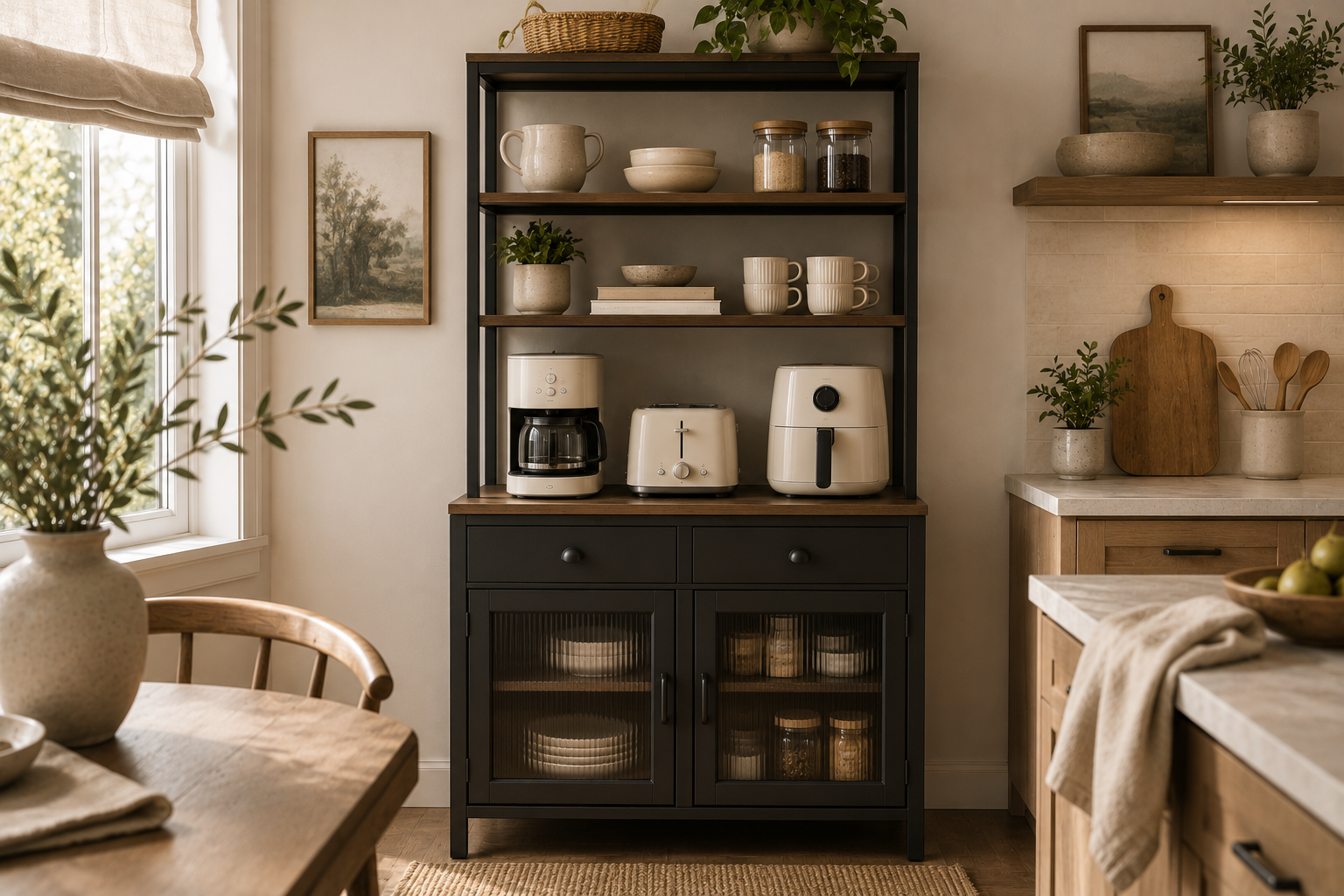
A small appliance hutch solves this differently than a built-in solution would. Instead of modifying the cabinets you already have, you’re adding a self-contained piece of furniture, closed storage on the bottom, often open shelving or a hutch top above, that gives your appliances a home without asking your landlord (or your budget) for anything more.
This is our guide to the best small appliance hutches for kitchens that are simply out of cabinet space, chosen for footprint, closed storage capacity, and whether they look like an intentional furniture piece rather than an obvious storage fix.
Key Takeaways
- A small appliance hutch is freestanding furniture, no installation, no cabinet modification, fully portable if you move
- Look for a closed lower cabinet section specifically sized for appliances, not just open shelving
- Standard appliance hutches range from 24 to 36 inches wide, measure your available wall space before choosing
- Solid or engineered wood in a finish matching your existing cabinets reads as furniture; unfinished MDF or bare metal reads as storage
- A hutch with a countertop-height surface can double as extra prep space, not just storage
- Ventilation matters if you’ll store a toaster or coffee maker inside while it’s still slightly warm
Appliance Hutch vs. Appliance Garage: What's the Difference?
If you’ve read our guide to freestanding appliance garages, you might be wondering how a hutch differs. The short answer: scale and structure.
An appliance garage is typically a small, single-purpose box, a roll-top or lift-door enclosure sized for one or two appliances, sitting directly on an existing counter. A hutch is a larger, standalone furniture piece, often floor-to-counter height or taller, with its own legs or base, closed cabinet doors on the bottom, and frequently open shelving or a hutch top above for display or additional storage.
If your kitchen has counter space but no appliance concealment, a garage is usually the better fit. If your kitchen is short on both counter and storage space, a hutch solves both problems in one purchase.
The Best Small Appliance Hutches
1. Compact Wood Kitchen Hutch with Closed Cabinet Storage
Best overall pick for a small kitchen
[LASSO BOX: Small Wood Kitchen Hutch, closed cabinet base, natural or espresso finish]
Look for a hutch in the 24 to 30-inch width range with a fully enclosed lower cabinet, this is the sweet spot for concealing one or two appliances without eating up your whole kitchen. A solid or engineered wood finish that matches your existing cabinetry is what separates a hutch that reads as furniture from one that reads as an obvious storage bin. Brands like Sauder and Yaheetech consistently produce well-reviewed pieces in this size range with adjustable interior shelving, which lets you customize the cabinet height to fit a taller stand mixer or a shorter toaster.
Pros: Genuine furniture presence, adjustable interior shelving in most models, widely available in multiple finishes
Limitations: Assembly required on most models; measure doorway and hallway width if you’re navigating a narrow apartment entry
2. Metal-Frame Pantry Hutch with Appliance Cabinet
Best for a modern or industrial kitchen palette
[LASSO BOX: Metal-Frame Pantry Cabinet with Closed Doors, black or white finish]
For kitchens with black or brushed-steel hardware, a metal-frame hutch blends in far better than a wood-tone piece would. Brands like GAIOUS and SteeLoong produce tall, narrow metal cabinets with adjustable shelves that work well for appliance concealment on the lower shelves while keeping cookbooks or serving pieces visible on top. The powder-coated finish wipes clean easily, which matters near anything that occasionally drips or splatters.
Pros: Easy to wipe clean, strong modern aesthetic, typically more affordable than solid wood options
Limitations: Less warmth than a wood-tone piece; can feel visually heavy in a very small room if not paired with lighter surrounding decor
3. Slim Coffee Bar Hutch with Cabinet Base
Best for a dedicated coffee and breakfast zone
[LASSO BOX: Slim Coffee Bar Hutch with Cabinet Storage, narrow footprint]
If your main need is concealing a coffee maker and the mugs, filters, and syrups that come with it, a coffee-bar-style hutch is purpose-built for exactly that. These tend to run narrower than general appliance hutches, often 20 to 24 inches wide, which makes them a better fit for a tight kitchen corner or an awkward gap between a fridge and a wall.
Pros: Narrow footprint fits tight corners, purpose-built for a coffee-and-breakfast routine, often includes a small countertop surface
Limitations: Limited to one appliance zone rather than general storage; less useful if you need to hide multiple larger appliances
4. Kitchen Island Cart with Enclosed Storage
Best for a small kitchen that also needs extra prep space
LASSO BOX: Rolling Kitchen Island with Cabinet Doors and Butcher Block Top]
Pros: Solves two problems at once, concealment and extra counter space, often includes a spice rack or towel bar on the side, fully portable on casters
Limitations: Larger footprint than a dedicated hutch; check that your kitchen has enough floor clearance before buying
What to Measure Before You Buy
- Available wall or floor space, width and depth. Small appliance hutches typically range from 20 to 36 inches wide and 14 to 18 inches deep. Measure your intended spot precisely, and account for door swing if the hutch has hinged cabinet doors rather than sliding ones.
- Appliance height with lid or hood open, the same rule that applies to appliance garages, if your toaster has a bagel-mode lever or your coffee maker has a top-loading reservoir, measure with that feature in its open position.
- Doorway and hallway clearance. Fully assembled hutches can be large and awkward to move through narrow apartment doorways or stairwells. Check whether your chosen model ships flat-packed for assembly inside the room, which solves this problem entirely.
- Weight capacity of interior shelves, especially if you’re storing a heavier appliance like a stand mixer or multi-cooker rather than a lightweight toaster
How to Style an Appliance Hutch So It Reads as Furniture
The biggest styling mistake is choosing a hutch that doesn’t match anything else in your kitchen’s material palette. A mismatched wood tone, or a finish that clashes with your existing cabinets, immediately signals “storage furniture” rather than “intentional piece”, the same principle we cover in the “Material Monotony” section of our 3-Object Rule guide.
If your hutch includes open shelving on top, treat that surface the same way you’d treat any other visible zone in your kitchen, a maximum of three styled objects, not a dumping ground for whatever doesn’t fit in the cabinet below. A stack of cookbooks, one plant, and a ceramic canister reads as intentional; a cluttered mix of mail, keys, and loose papers undoes the whole point of adding the hutch in the first place.
Position also matters. A hutch placed in an underused corner or against an empty wall reads as a deliberate addition to your kitchen’s layout. One wedged awkwardly into your main walking path will always feel like an obstacle, regardless of how nice it looks.
Frequently Asked Questions
1. What is a small appliance hutch?
A small appliance hutch is a freestanding piece of kitchen furniture with closed cabinet storage, often paired with open shelving above, designed to hide small countertop appliances like toasters, coffee makers, and mixers when a kitchen has run out of cabinet space.
2. What's the difference between an appliance hutch and an appliance garage?
An appliance garage is typically a small, single-purpose box that sits on an existing counter and conceals one or two appliances. A hutch is a larger, standalone furniture piece with its own base or legs, closed cabinet doors, and often additional storage or display shelving, better suited to kitchens that need both appliance concealment and general storage.
3. How much space do I need for a small appliance hutch?
Most small appliance hutches range from 20 to 36 inches wide and 14 to 18 inches deep. Measure your intended spot carefully, including clearance for any hinged cabinet doors to open fully.
4. Can an appliance hutch go in a rental kitchen?
Yes. Freestanding appliance hutches require no installation or wall modification, making them a straightforward option for renters. Just confirm the assembled piece will fit through your doorways and hallways before purchasing.
5. Do appliance hutches provide enough ventilation for warm appliances?
Check that your chosen hutch has some back or side ventilation, especially if you plan to store a toaster or coffee maker while it’s still slightly warm from use. Fully sealed cabinets without any airflow are better suited to cool, non-electric storage.
6. Is a hutch or a rolling cart better for a small kitchen?
It depends on your primary need. A hutch is the better choice if you mainly need concealed storage and don’t have extra floor space to spare. A rolling cart or island is the better choice if you also need additional counter or prep space, since most include a usable top surface in addition to storage.
A small kitchen doesn’t have to mean visible clutter just because the cabinets ran out. A well-chosen appliance hutch gives your daily-use appliances a proper home, one that looks like it was always meant to be there.