
Disclosure: As an Amazon Associate, I earn from qualifying purchases. This post contains affiliate links, which means we may receive a small commission, at no extra cost to you, if you make a purchase through a link. This helps support our independent research and the maintenance of Lune & Ivory.
Interior designers have been calling it for months now: terracotta is the defining kitchen color of 2026. Warm, sunbaked, and grounded in a way that white and gray kitchens simply aren’t, it’s showing up in cabinet fronts, tile backsplashes, and full accent walls across nearly every major design publication this year.
Most of that coverage assumes you’re renovating. New cabinets, custom tile, a repainted wall. If you rent your kitchen, or you’re not ready to commit to a color that permanent, none of that is realistic, and yet the appeal of terracotta’s warmth doesn’t go away just because a full remodel isn’t an option.
The good news is that terracotta works just as well as an accent as it does a full commitment. This is our guide to bringing 2026’s biggest kitchen color into your space through decor, cookware, and small accessories, no contractor required.
Key Takeaways
- Terracotta works best as an accent layered against natural materials, wood, stone, and cream, rather than as the dominant color in a small kitchen
- The easiest entry points are cabinet hardware, dishware, and small decorative pieces, not walls or tile
- Terracotta pairs especially well with sage or olive green, both trending alongside it in 2026
- A single terracotta object in each functional zone (per our 3-Object Rule) is often more effective than scattering small terracotta touches everywhere
- Warm-toned lighting enhances terracotta’s natural depth; cool white light can flatten it
- You can fully reverse this look later, nothing here requires permanent commitment
Why Terracotta Is Having a Moment in 2026
Interior designers point to a few consistent reasons terracotta has taken hold this year. It has what one designer called a “sunbaked quality”, a warmth that feels grounded and inviting rather than trend-driven or cold, which matters especially in a kitchen, the room most homes actually gather in. It’s also a color with history. Unlike many trend colors that feel disconnected from anything, terracotta carries a sense of craft and material honesty, since it comes directly from fired clay rather than a manufactured pigment.
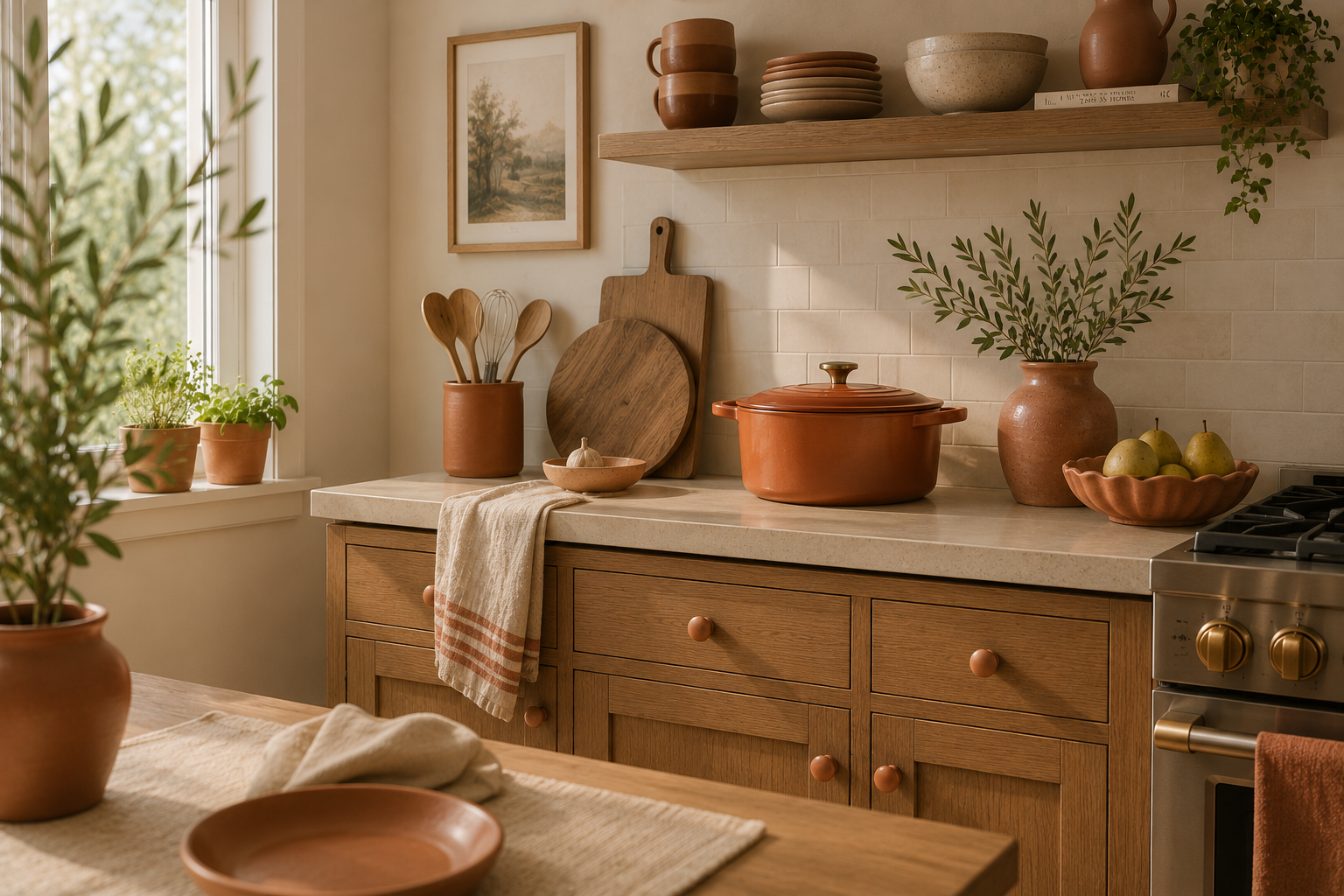
Crucially for renters and small-space dwellers, designers are also emphasizing that terracotta doesn’t need to dominate a room to work. It’s most effective when it “has room to breathe” against natural materials, wood tones, stone, and warm neutrals, which means a few well-placed accents can capture the feeling of the trend without any of the commitment of a renovation.
How to Add Terracotta Without Renovating
1. Start With Cabinet Hardware
This is the lowest-commitment entry point available, and one most kitchen-color guides overlook entirely. Swapping standard cabinet knobs and pulls for terracotta-toned ceramic or enameled hardware adds the color in small, repeated doses throughout the kitchen without ever touching a wall or a cabinet front.
[LASSO BOX: Terracotta Ceramic Cabinet Knobs, Set of 6-10]
2. Layer In Terracotta Cookware and Dishware
Tableware and cookware are the most natural, functional way to bring the color in, since these are pieces you’re already buying and using regularly. A terracotta Dutch oven, a set of stoneware mugs, or simple ceramic plates in a burnt-clay glaze do double duty as everyday tools and as decor.
[LASSO BOX: Terracotta Enameled Dutch Oven]
[LASSO BOX: Terracotta Stoneware Mug Set]
3. Add Terracotta Planters for Kitchen Herbs
If you keep fresh herbs on a windowsill or open shelf, this is one of the most authentic ways to bring terracotta in, the material’s original, traditional use. A row of small terracotta pots with basil, thyme, or mint adds color, texture, and function in one move.
[LASSO BOX: Small Terracotta Herb Pots, Set of 3]
4. Introduce a Terracotta Vase or Decorative Bowl
A single terracotta vase or wide decorative bowl on open shelving or a countertop is often more effective than multiple smaller pieces scattered throughout the kitchen. Under our 3-Object Rule, a single, well-placed terracotta object can anchor an entire zone without overwhelming a small kitchen’s visual balance.
[LASSO BOX: Terracotta Ceramic Vase or Decorative Bowl]
5. Consider a Terracotta Runner or Woven Textile
A patterned kitchen runner or table linen in terracotta and cream tones brings the color to floor or table level without any permanence, these are easy to swap out entirely if your taste changes.
[LASSO BOX: Terracotta and Cream Woven Kitchen Runner]
What Terracotta Pairs Well With
Designers consistently point to the same handful of pairings that make terracotta feel intentional rather than random:
- Sage and olive green — one of the most-cited pairings in 2026 design coverage and a natural fit if you’re already leaning into green as a kitchen neutral. The combination feels earthy and Mediterranean without veering costume-y.
- Natural wood tones — oak, walnut, and light ash all let terracotta “breathe,” as designers put it, rather than compete with it. This is the pairing that works best specifically in a warm-minimalist kitchen.
- Cream and warm white — keeps a small kitchen feeling airy even with a saturated accent color added and prevents terracotta from making a compact space feel smaller or heavier.
- Brass and warm metal accents — hardware, light fixtures, or small trim details in brass or aged gold pick up terracotta’s warmth rather than clashing with its earthiness the way cooler chrome or stainless tones sometimes can.
Avoid pairing heavy terracotta accents with very cool-toned grays or stark white marble, designers note this combination can make terracotta read as jarring rather than warm, since the two color temperatures actively fight each other.
Lighting Matters More Than You'd Think
Terracotta’s depth comes through best under warm-toned light. Cool white bulbs (5000K and above) tend to flatten the color, making it look more muted orange than richly clay-toned. If you’re adding terracotta accents to a kitchen with cool overhead lighting, consider swapping to warm white bulbs (2700–3000K) in at least your task or under-cabinet lighting, the same principle we cover in our Light Map Method guide, where light temperature shapes how every material and color in a room actually reads
How to Keep It From Feeling Overwhelming in a Small Kitchen
The biggest risk with any trend color in a small space is oversaturation too much terracotta reads as costume rather than considered design, especially in a compact room where every surface is visible at once.
The safest approach is to treat terracotta as an accent color that appears in no more than two or three places at a time: perhaps your cabinet hardware, one piece of cookware left out on display, and a single vase or bowl. This mirrors the same “visual budget” logic from our 3-Object Rule, a small kitchen has limited visual real estate, and terracotta earns its spot best when it isn’t competing with too many other colors or textures for attention.
Frequently Asked Questions
1. Is terracotta a passing trend or a lasting kitchen color?
Designers are largely describing terracotta as a color with staying power rather than a fleeting trend, pointing to its historical use and natural material connection. That said, treating it as an accent rather than a full renovation commitment is the safest way to enjoy the trend now without regretting a permanent choice later.
2. How do I add terracotta to a rental kitchen?
Cabinet hardware, cookware, dishware, small planters, and textiles are the easiest renter-friendly ways to bring terracotta into a kitchen without any permanent changes. All of these can be removed or swapped out entirely when you move.
3. What colors pair best with terracotta in a kitchen?
Sage or olive green, natural wood tones, cream and warm white, and brass or warm metal accents are the most consistently recommended pairings. Avoid pairing heavy terracotta with very cool grays or stark white marble, which can make the color feel jarring rather than warm.
4. Will terracotta make my small kitchen feel smaller?
Not if used as an accent rather than a dominant color. Limiting terracotta to two or three focal points, rather than scattering it throughout every surface — keeps a small kitchen feeling open while still capturing the warmth of the trend.
5. Does terracotta work in a modern or minimalist kitchen, or only rustic ones?
Terracotta works well in a wide range of styles, including modern and minimalist kitchens, when paired with clean lines and a restrained color palette. The key is balance, a modern kitchen with terracotta accents against white or cream surfaces reads as intentional, not rustic by default.
6. What kind of lighting makes terracotta look best?
Warm-toned lighting, generally in the 2700–3000K range, brings out terracotta’s natural depth and richness. Cool white lighting (5000K and above) tends to flatten and mute the color.
Terracotta doesn’t require a renovation to earn its place in a small kitchen, a few well-chosen pieces, layered against the wood and cream tones already there, do the job just as well. That’s the whole appeal of a color this grounded: it was never meant to shout.