Disclosure: As an Amazon Associate, I earn from qualifying purchases. This post contains affiliate links, which means we may receive a small commission, at no extra cost to you, if you make a purchase through a link. This helps support our independent research and the maintenance of Lune & Ivory.
Every lab-tested blender roundup asks the same three questions: does it crush ice, how loud is it, and how fast does it purée. Those questions matter. But if you live in a small kitchen and this blender is going to live out on your counter every single day, not tucked in a cabinet, not hauled out twice a week, there’s a fourth question nobody else is asking: does it actually look good sitting there?
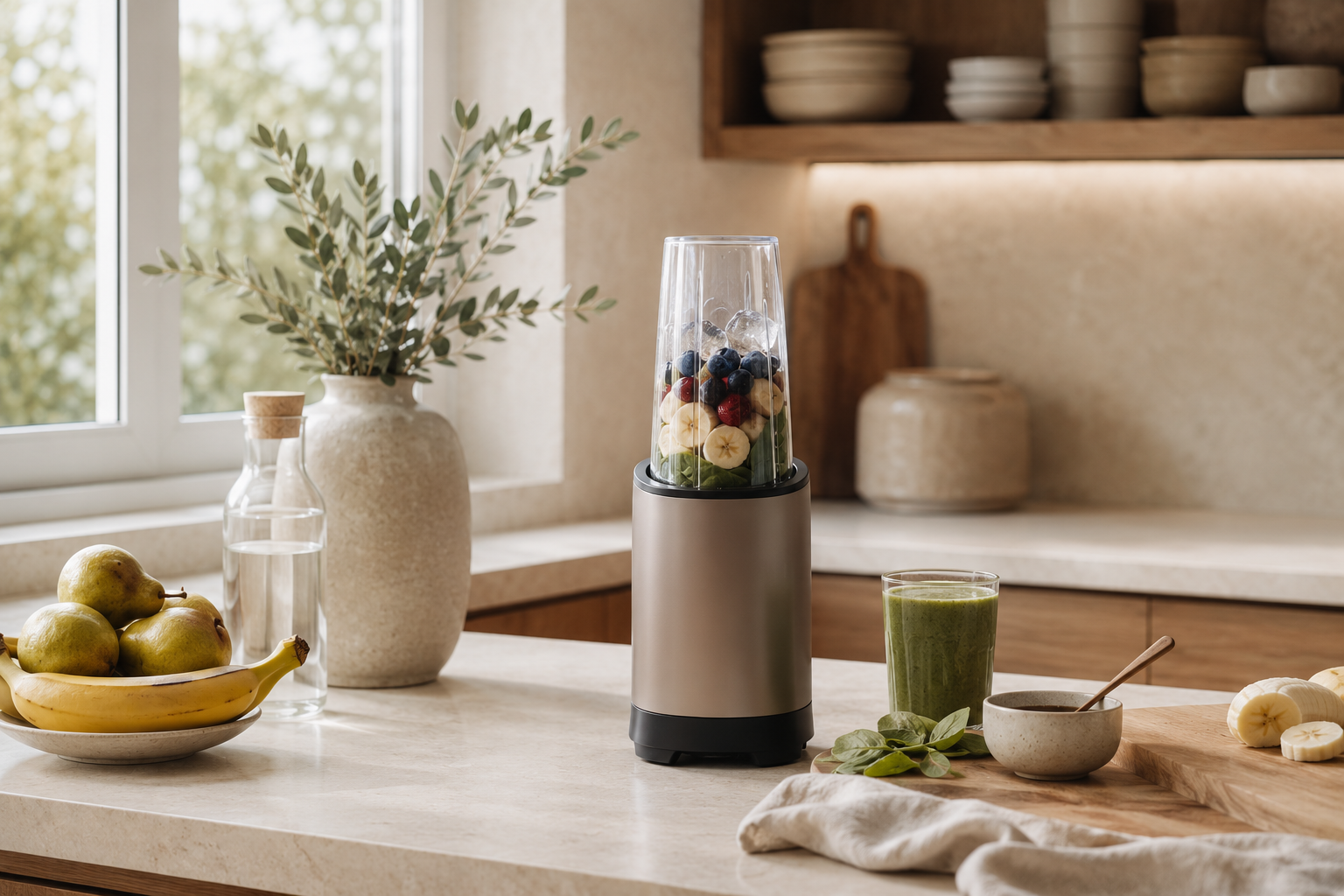
A personal blender earns permanent counter space in a way a full-size pitcher blender rarely does. It’s smaller, it’s used daily, and in a compact kitchen, it’s often visible from your living room, your entryway, or wherever else your open-plan layout puts the kitchen on display. That means the blender you choose is doing double duty, appliance and décor object, whether you intended it to or not.
This is our guide to the best personal blenders for a small kitchen, evaluated for power and practicality the way every other list does, but with an equal weight on whether it earns its spot in a room you’re trying to keep calm and considered.
Key Takeaways
- A personal blender that lives permanently on your counter should be evaluated on looks as much as power, you’ll see it every day
- Most personal blenders run 250–1,000 watts; more watts generally means better ice-crushing and smoother purées, but also more noise
- Wavy-wall or single-serve cup designs tend to blend more evenly than straight-walled cups, since ingredients cycle through the blades more effectively
- Self-cleaning functions are a genuine time-saver for daily use, worth prioritizing over a slightly lower price
- Match your blender’s color to your existing kitchen palette; a mismatched appliance reads as clutter even when it’s small
- Budget options ($20–$40) handle smoothies well but struggle with ice; premium options ($100+) handle both
The Best Personal Blenders for a Small, Stylish Kitchen
1. Our Place Splendor Blender
Best overall for warm-minimalist kitchens
[LASSO BOX: Our Place Splendor Blender, 1000W, in Steam (cream) or Spice (terracotta)]
This is the blender that started the “does it actually look good” conversation, and it’s the first one I’d point a design-conscious reader toward. The wavy-walled vessel and heavy, stable base give it a sculptural quality most personal blenders don’t have, and it comes in four colorways, including a warm cream (“Steam”) and a soft terracotta (“Spice”) that slot directly into a warm-minimalist palette without a second thought.
At 1,000 watts, it handles smoothies, purées, and sauces smoothly, and the self-cleaning function (soap, water, one button) is a genuine daily-use convenience. It’s not without tradeoffs: independent testers have found it less consistent at fully crushing ice than pricier full-power blenders, and it runs a bit louder and less stable at full speed than some competitors. If your daily use is smoothies, sauces, and dressings rather than crushed-ice drinks, those tradeoffs won’t matter much.
- Pros: Genuinely beautiful, colors match warm-minimalist palettes, self-cleaning, wide-mouth vessel blends evenly, lightweight and easy to lift
- Limitations: Inconsistent with straight ice-crushing, louder at top speed, premium price point (~$125)
2. Beast Mini Personal Blender
Best alternative aesthetic pick
[LASSO BOX: Beast Mini Personal Blender]
If you want the same “this looks intentional, not utilitarian” quality but prefer a different silhouette, the Beast Mini is the other name that keeps coming up in design-forward blender comparisons. Its hourglass-shaped vessel and matte finish give it a similarly sculptural quality, and it’s built specifically around the single-serve, leave-it-out-daily use case.
Pros: Distinct, attractive silhouette, compact footprint, built for daily countertop use
Limitations: Smaller accessory ecosystem than more established brands; check current color availability before buying.
3. Magic Bullet Personal Blender
Best budget pick
[LASSO BOX: Magic Bullet Personal Blender, compact set]
The original in this category, and still the simplest. No settings, no buttons, fill the cup, twist on the blade, flip it onto the base, and push down to blend. It won’t win any design awards, but its small, unobtrusive cylindrical shape is easy to tuck into a corner or a shelf if you don’t want it permanently visible, and it’s one of the most affordable ways into this category.
Pros: Very affordable, extremely simple to use, compact enough to store rather than display
Limitations: Plain utilitarian design, less powerful than premium picks, better suited to smoothies than ice or tough purées
4. NutriBullet Pro 900
Best for daily smoothie power on a mid-range budget
[LASSO BOX: NutriBullet Pro 900 Personal Blender]
A dependable mid-range choice if power matters more to you than styling. The 900-watt motor handles smoothies and frozen fruit well, and it’s one of the most widely reviewed personal blenders on the market, which makes it an easy, low-risk choice if you’re not picky about aesthetics. It runs louder than the pricier picks above, and the rubber gasket seal has been flagged in some reviews as prone to slipping if not seated carefully, worth double-checking before each use.
Pros: Strong smoothie and ice performance for the price, widely available, huge review base to reference
Limitations: Utilitarian design, notably loud, gasket seal requires careful seating each use
What Actually Matters When Choosing One for a Small Kitchen
- Wattage. Most personal blenders fall between 250 and 1,000 watts. Higher wattage generally means smoother purées and better ice-crushing, but it usually also means more noise, a real consideration if your kitchen is open to a living space where noise carries.
- Vessel shape. Wavy-walled or tapered vessels tend to cycle ingredients through the blades more evenly than straight-sided cups, which reduces the need to stop, stir, and re-blend.
- Self-cleaning. A genuinely underrated feature for daily use. A blender you have to hand-scrub every morning is a blender you’ll eventually stop using.
- Footprint and visibility. If it’s going to live out on your counter permanently, treat the color and shape decision the same way you’d treat any other visible object in the room, under our 3-Object Rule, an appliance counts as one of your three visible items in a zone, so it needs to earn that spot both functionally and visually.
- Noise. If your kitchen opens into a living or sleeping area, a loud blender at 7am is a real household consideration, not a minor spec.
Matching Your Blender to Your Kitchen Palette
This is the step every lab-tested roundup skips entirely, and it matters more than people expect.
- Cream, sage, and marble kitchens- the Our Place Splendor Blender’s “Steam” cream colorway or a simple white NutriBullet blend in almost seamlessly.
- Oak, terracotta, and clay kitchens- the Splendor Blender’s “Spice” terracotta option is close to an exact palette match, and it’s one of the few personal blenders on the market designed with warm tones as a genuine first-class option rather than an afterthought.
- Matte black or modern kitchens- the Beast Mini’s dark, matte finish suits high-contrast, minimal-but-modern spaces better than the softer cream tones above.
If you’re already building out a considered kitchen using our Amazon Basics kitchen finds or thinking through your appliance placement the way we cover in our 3-Object Rule guide, your blender choice should follow the same logic: pick one, let it earn its visible spot, and stop there.
Frequently Asked Questions
1. What is the best personal blender for a small kitchen?
The Our Place Splendor Blender is our top pick for small, design-conscious kitchens, it’s powerful enough for daily smoothies and purées, includes a genuine self-cleaning function, and comes in colorways (cream and terracotta) that blend into a warm-minimalist palette rather than standing out as clutter.
2. Are personal blenders powerful enough to crush ice?
It depends on the model and wattage. Higher-wattage options (900–1,000W) handle ice reasonably well, though independent testing shows even premium personal blenders can be less consistent with ice than full-size blenders. If crushed-ice drinks are a daily habit, prioritize wattage and read ice-specific test results before buying.
3. Do personal blenders take up less space than regular blenders?
Yes, significantly. Most personal blenders are designed to be lifted and used with one hand and stored in a small footprint, compared to a full-size pitcher blender that typically needs a dedicated corner or cabinet shelf.
4. Can a personal blender replace a food processor?
For light tasks, sauces, dips, small-batch purées, yes, in many cases. For heavier chopping, shredding, or large-batch prep, a dedicated food processor will still perform better.
5. How do I clean a personal blender?
Most have dishwasher-safe components, though hand-washing prolongs their life. Models with a self-cleaning function (like the Our Place Splendor Blender) let you add soap and water to the vessel and run a short cycle, which is significantly faster for daily use than full hand-washing.
6. Is it worth paying more for a stylish personal blender?
If the blender is going to live permanently on your counter in view, yes, the extra cost buys you an appliance that functions as a decor piece rather than visual clutter. If you plan to store it in a cabinet and only pull it out occasionally, a budget pick with less design emphasis is a reasonable way to save money.
A personal blender is one of the few appliances that genuinely earns daily counter space in a small kitchen. Choose one that does the job well, and one you don’t mind looking at every single morning.