Disclosure: As an Amazon Associate, I earn from qualifying purchases. This post contains affiliate links, which means we may receive a small commission, at no extra cost to you, if you make a purchase through a link. This helps support our independent research and the maintenance of Lune & Ivory.
The fastest way to judge the mental health of a home is to look at its kitchen countertops. In a standard kitchen layout and especially in a tight 10×10 footprint, counters are a magnet for passive accumulation. A rogue vitamin bottle here, a stack of mail there, a collection of mismatched cooking oils by the stove. Within a week, a space meant for creation becomes a monument to unfinished business.
We often think the solution is total erasure: clearing everything off until the kitchen looks like an unlived-in showroom. But extreme minimalism can feel sterile, cold, and entirely impractical for a home that actually loves to cook.
At Lune & Ivory, we don’t design for empty perfection; we design for Visual Quiet. The goal isn’t to have nothing on your counters; it is to have intentional negative space that lowers your cortisol levels the moment you walk into the room. To achieve this balance, we use our most transformative styling guardrail: The 3-Object Rule. Here is exactly how to apply it to your kitchen today.
If you want to de-stress your kitchen layout right now, here’s the baseline blueprint:
- Stop thinking of your counter as one long continuous shelf. Break up into discrete, functional action zones. (The Brew Zone, The Prep Zone, The Cooking Zone).
- No one deliberate functional zone should have more than three deliberate items left out on display.
- Use trays, boards, or pedestals to gather several functional items together on one visual plane, so your brain sees them as one object.
The Psychological Basis of the "3-Object" Limit
Why three? Three is the magic number for asymmetry and visual balance in environmental psychology and design. One thing may look accidental, two produce a rigid symmetry, but three make a dynamic composition that feels finished without crowding.
More importantly, a limit of three objects per zone puts a strict boundary. It halts Clutter Creep. When an item doesn’t fit into the three designated, it makes you decide right away: does this go in a cabinet or replace something already on display?
In a 10×10 kitchen, your brain interprets every visible item as a micro-task. A crowded counter whispers that there is work to be done. By enforcing at least 40% visible negative space between your objects, you give your mind a visual buffer to rest.
How to Style the Zones: Real-Life Blueprints
To execute this rule, you must first divide your countertop into its natural functional zones. Here is exactly how we style the three primary zones of a warm, minimalist kitchen.
Zone A: The Coffee Corner (The Vertical Stack)
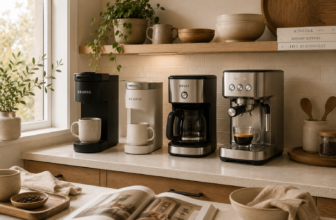
Your morning routine should be free of friction. Instead of a sprawling espresso bar that takes up three feet of horizontal space, keep the footprint entirely vertical.
- Object 1 (The Base): An airtight, wooden-top pod drawer that holds your capsule inventory out of sight.
- Object 2 (The Machine): Your slim espresso maker stacked directly on top of the drawer (combining with the drawer to read as one visual unit).
- Object 3 (The Ritual): Your favorite everyday ceramic mug sitting alongside it.
The “Lune” Take: This is the “pedestal” your machine deserves. It specifically fits the wider Vertuo pods and provides a sturdy wood surface that ties into our Material Monotony principle. It turns your coffee setup into a single, cohesive piece of Functional Art.
- Sturdy wood surface that matches the “Material Monotony” of a warm kitchen.
- Completely encloses inventory to eliminate the visual noise of colorful pods.
- Acts as a structural pedestal to elevate your machine vertically.
The “Lune” Take: Stacking your machine directly on top of this drawer turns your coffee station into a singular piece of functional art. It satisfies the 3-Object rule perfectly by keeping the horizontal counter completely open for actual food prep.
Zone B: The Stove Station (The Cooking Anchor)
The area immediately surrounding your range is the highest-risk zone for clutter accumulation. To keep it clean yet supportive while you cook, limit it to:
- Object 1 (The Platform): A beautiful, oversized wooden cutting board resting over the burners or directly beside the stove.
- Object 2 (The Tool Vessel): A singular matte ceramic crock holding only your daily wooden utensils.
- Object 3 (The Seasoning Tray): A small stone tray holding a premium olive oil dispenser and a salt cellar.
The Designer's Secret: Stacking & Corralling
The most common question we get is: “What if I genuinely need four or five things in one zone?” This is where the concept of visual framing comes in. If you have a bottle of olive oil, a salt cellar, a pepper grinder, and a garlic keeper sitting loose on your counter, your brain reads that as four separate distractions.
But the moment you place those exact same four items inside a single, low-profile ceramic or marble tray, they instantly become one single object to your eye. The tray acts as a boundary line, wrapping the items into a single visual package.
The Bridge Material
Always use natural, tactile materials to frame your groups. A high-quality over-the-stove board or a shallow stoneware tray adds that rich, organic texture that keeps a minimalist space from feeling too sterile or cold. It turns your daily utility tools into an intentional vignette.
The "Fast Reset" Habit Loop
The 3-Object Rule is only as good as your daily habits. A well-designed kitchen is an ongoing lifestyle system, not a one-time project. This is why we rely on the nightly Clear-to-Neutral routine. Before you go to bed, spend exactly five minutes resetting your zones:
- Wipe down the open negative spaces.
- Tuck away any items that migrated to the counter during the day (mail, grocery receipts, rogue keys).
- Return your zones strictly to their designated three objects.
Walking into a completely reset, visually quiet kitchen the next morning protects your energy. It ensures your brain stays in a calm, intentional headspace to start your day, rather than launching directly into a state of chore-induced stress.
Frequently Asked Questions
1. Where do the everyday ugly items go, like the dish sponge and dish soap?
Leaving a bright neon plastic bottle of dish soap and a half-wet yellow sponge on the edge of the sink is an instant visual disruptor. To fix this, decant your dish soap into a sleek matte black or amber glass pump bottle. For the sponge, use a low-profile, ceramic soap dish that sits behind the faucet, or mount a small magnetic holder inside the lip of your sink so it stays completely hidden below the counter line.
2. Does an appliance like a microwave or a double airfryer count as an object?
Yes, and because they have massive visual weight, they should occupy their own dedicated zone. As discussed in our Ninja DualZone Review, we cluster our heavy-hitting appliances tightly together in a single functional corner. This turns that entire corner into a single, intentional “Appliance Workstation,” leaving the remaining zones of your countertops free to enjoy pure negative space.
3. How do I handle fruit bowls or fresh herbs?
A beautiful bowl of fresh lemons or a small pot of green basil is an exceptional choice for one of your three objects. Natural, living elements introduce warmth and organic movement to a minimalist kitchen. Just ensure the vessel housing them (a stoneware bowl or a terracotta pot) fits your kitchen’s overarching material palette.
Enforcing the 3-Object Rule isn’t about restricting your daily life; it is about liberating your mental space. By creating clear boundaries on your countertops, you strip away the background noise of your home and turn your kitchen back into what it was always meant to be: a calm, supportive sanctuary for your routine.
Now that your counters are beautifully styled and clear of visual noise, it’s time to ensure your appliances match this level of efficiency.