Disclosure: As an Amazon Associate, I earn from qualifying purchases. This post contains affiliate links, which means we may receive a small commission, at no extra cost to you, if you make a purchase through a link. This helps support our independent research and the maintenance of Lune & Ivory.
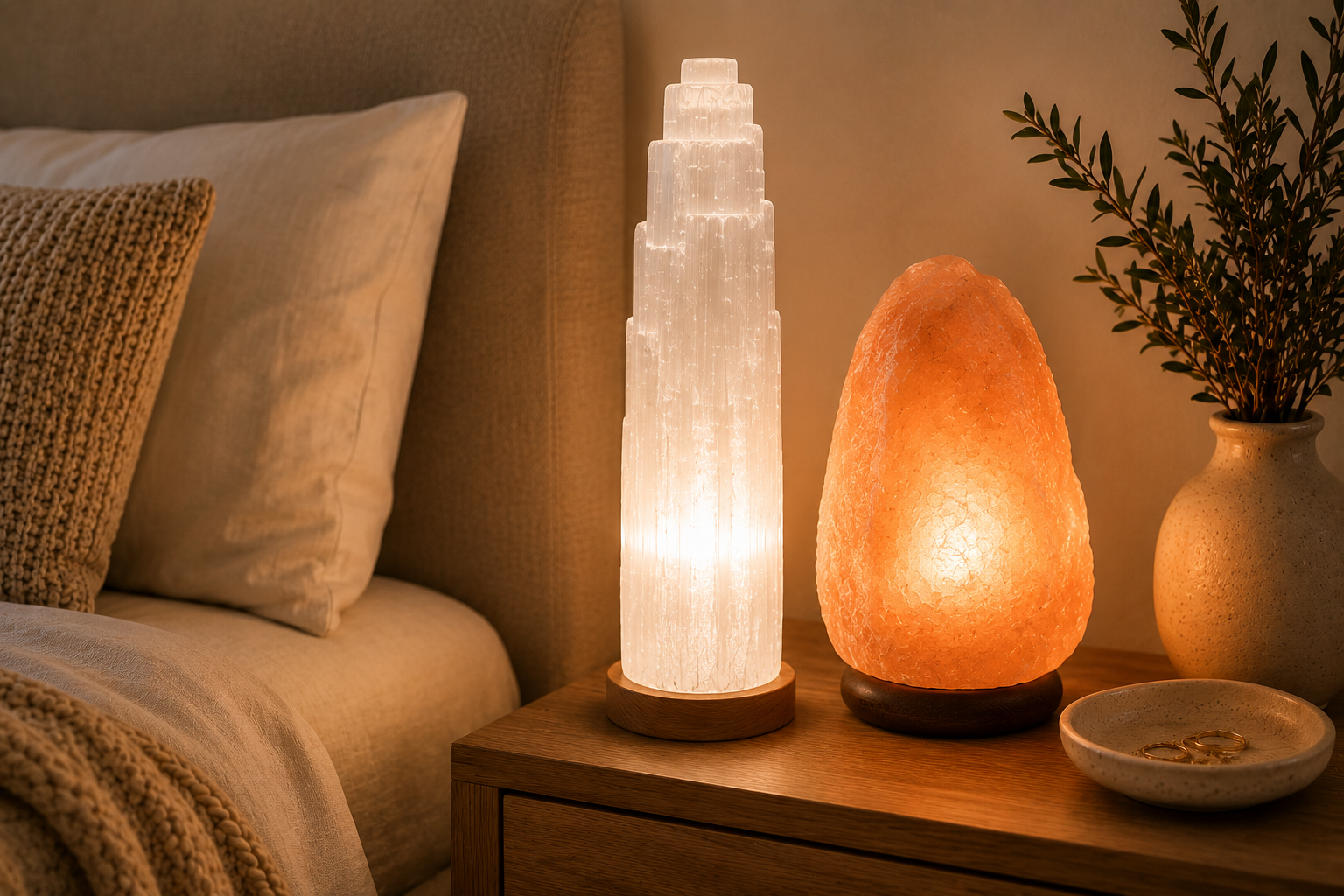
Two of the most quietly popular ambient lamps in considered home design look almost nothing alike. One glows soft amber, like a candle flame trapped in stone. The other glows crisp, snowy white, like a small block of moonlight on the nightstand.
Both are sold as bedside lamps. Both have a loyal following in the wellness and warm-minimalist communities. Both will catch the eye of anyone visiting your bedroom for the first time. But they create completely different atmospheres and which one belongs in your home depends far more on your light temperature preference, palette, and bedroom orientation than on any of the spiritual or air-quality claims that dominate the conversation online.
This is a design-first comparison of the selenite lamp vs Himalayan salt lamp, what each one is, how the light actually behaves, and which fits the warm-minimalist home best.
Key Takeaways
- Selenite lamps emit a cool, crisp white light that suits cream, sage, marble, and modern minimalist palettes
- Himalayan salt lamps emit a warm amber glow that suits oak, terracotta, wool, and warm minimalist palettes
- Selenite is lighter, brittle, and prone to shedding fibers, handle carefully
- Salt lamps are heavier and absorb humidity, they need to be turned on regularly to stay dry
- Neither lamp should be near water, and both are unsuitable for bathrooms or kitchens
- Your bedroom’s natural light direction (covered in our Light Map Method) is the strongest signal for which lamp will feel right
- For warm winding-down ambiance: salt lamp. For brighter, clarifying ambient light: selenite
Quick Comparison
|
|
Selenite Lamp
|
Himalayan Salt Lamp
|
|---|---|---|
|
Light Color
|
Cool white
|
Warm amber/pink
|
|
Material
|
Selenite crystal (gypsum)
|
Pink Himalayan salt
|
|
Best Palett
|
Cream, white, sage, marble
|
Oak, terracotta, wool, clay
|
|
Weight
|
Light, brittle
|
Heavy, solid
|
|
Maintenance
|
Handle carefully, may shed
|
Keep on to manage humidity
|
|
Mood
|
Bright, clarifying
|
Warm, grounding
|
|
Pick If
|
You want minimalist cool light
|
You want a soft winding-down glow
|
What Is a Selenite Lamp?
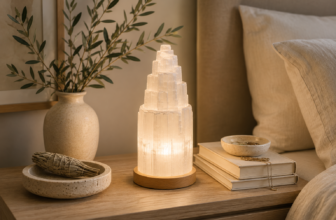
A selenite lamp is carved from selenite, a translucent, fibrous form of gypsum that has been used for sculptures and decorative pieces for thousands of years. The lamps themselves are usually shaped into clean towers or natural obelisk forms, hollowed out to hold a small bulb that lights up the entire crystal from within.
The light that comes through is crisp, snowy white, closer to moonlight than to candlelight. Because selenite is naturally translucent, the entire piece glows evenly, almost like an internally lit sculpture. In the wellness community, selenite is often associated with mental clarity, calm, and meditative spaces, though these traditional associations sit outside what design or scientific reviews can verify.
What’s measurable, and what matters for your home, is the light itself. Selenite emits a brighter and cooler ambient glow than nearly any other natural lamp in this category. That makes it an exceptional pairing for cream, sage, marble, and modern minimalist palettes where warm-toned lamps would clash.
What Is a Himalayan Salt Lamp?
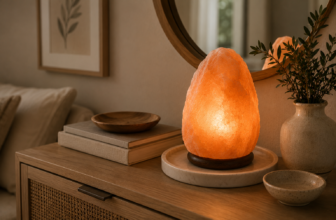
A Himalayan salt lamp is carved from pink Himalayan rock salt mined in Pakistan. The bulb sits inside the hollowed-out salt block and warms it gently, casting an amber-to-pink glow that closely resembles candlelight or a wood-burning fire.
Himalayan salt lamps are often associated with air purification and negative ion release in popular wellness writing, though the scientific consensus on these effects is limited and contested. What is undisputed is that the lamp produces one of the warmest, most candle-like ambient glows you can plug into a wall and that quality is the real reason it has become a fixture in warm-minimalist bedrooms.
The shape varies from natural rough-cut forms (each one entirely unique) to clean carved geometric shapes that suit more modern interiors. They are heavy, solid, and tactile, the weight itself gives them a grounded, anchoring feeling on a nightstand.
We cover our full picks in our Himalayan salt lamp review by room size, including which sizes work in studios versus master bedrooms.
The Light Comparison: Warm vs Cool
This is where the selenite lamp vs Himalayan salt lamp comparison stops being academic and starts mattering for your sleep.
Warm light (the salt lamp’s territory) sits at roughly 1800–2200K, comparable to candlelight. Warm-spectrum light is gentler on circadian rhythms in the evening, which is why most evening-friendly lighting guides recommend it for bedrooms and reading corners.
Cool light (selenite’s territory) sits closer to 4000–5000K, depending on the bulb used. Cool light reads as more clarifying and brighter, beautiful as an accent piece, but less ideal as your final light before sleep.
This is why your bedroom’s natural light direction matters so much. A north-facing bedroom that receives flat, cool light all day will feel cold and clinical with a selenite lamp added in the evening. The same selenite lamp in an east-facing bedroom, already warmed by morning sun, can feel beautifully balanced. We map this in detail in our Light Map Method guide.
How to Choose Based on Your Bedroom
- North-facing bedrooms- choose the salt lamp. North-facing rooms receive diffused, cool light all day and need warm artificial layering by evening.
- East-facing bedrooms- either works. Selenite suits the bright morning energy; the salt lamp grounds the room by evening. Many east-facing bedrooms benefit from owning both.
- West-facing bedrooms- choose the salt lamp. West-facing rooms already glow amber at golden hour; the salt lamp extends that warmth into the night beautifully.
- South-facing bedrooms- selenite balances the strong daytime warmth without making the room feel overheated.
Styling Each Lamp
This is where The Texture Rule earns its keep. In our Texture Rule guide, the natural and light layers do most of the warmth-creation work in any room, and these two lamps live in those layers.
- Selenite styles best with: pale linen bedding, cream boucle, white ceramic, sage, marble, brass, paper, glass. It functions as a light layer piece, reflective and bright. Pair it with sheer linen curtains and white walls to amplify its cool clarity.
Himalayan salt lamps style best with: warm oak nightstands, terracotta, wool, clay, leather, jute, brass. It functions as a natural layer piece, grounded, tactile, almost geological. Pair it with linen lampshades and wood-toned décor for a fully integrated warm-minimalist nightstand. See our warm minimalist nightstand essentials guide for our exact pairings.
Maintenance & Care
Both lamps are more delicate than they look.
Selenite is brittle and slightly fibrous, it can shed small flakes if handled roughly, and it should never come into contact with water (it will dissolve). Wipe gently with a dry cloth only.
Himalayan salt lamps absorb ambient humidity, they need to be left on for at least 12–16 hours a day to stay dry, otherwise moisture pools at the base and the lamp can “weep” or leak. They also dissolve in water and should never be placed near bathrooms or kitchens.
Both should sit on a stable, slightly raised surface and be kept away from open windows, plants that get misted, and humidifiers.
If your home runs on cream, white, sage, or marble and you want a brighter, clarifying ambient piece that doubles as a sculptural object, choose the selenite lamp.
If your home runs on oak, terracotta, wool, or clay and you want a soft, candlelit ambiance that supports winding down, choose the Himalayan salt lamp.
In a small bedroom, you rarely need both, but if you have space for one statement lamp and one accent, salt lamp on the nightstand and selenite on a shelf or windowsill is a beautifully balanced pairing.
Frequently Asked Questions
1. Is a selenite lamp better than a Himalayan salt lamp?
- Neither is objectively better, it depends entirely on your palette and the light atmosphere you want in your bedroom. Selenite emits cool white light suited to minimalist, cream-toned interiors. Himalayan salt lamps emit warm amber light suited to oak and terracotta interiors.
2. Can you sleep with a selenite lamp or salt lamp on?
- Many people leave Himalayan salt lamps on overnight because the warm amber glow doesn’t disrupt sleep the way blue or cool light can. Selenite lamps emit a cooler, brighter light, which is better used as an evening accent and turned off before sleep. Always check the bulb wattage and your specific lamp’s instructions.
3. Do Himalayan salt lamps actually purify the air?
- The claim that Himalayan salt lamps purify air or release significant negative ions is widely repeated in wellness writing but is not strongly supported by independent scientific research. We’d recommend buying one for its warm ambient glow and design value rather than for air-quality benefits.
4. Are selenite lamps fragile?
- Yes. Selenite is a soft mineral that can chip, shed small fibers, or crack if dropped. Place it somewhere stable where it won’t be knocked, and handle it carefully when cleaning.
5. Can selenite lamps and salt lamps go in the same room?
- Absolutely, they actually pair well if your palette includes both warm and cool neutrals. A common setup is a salt lamp on the nightstand for evening warmth and a selenite piece on a shelf or dresser for daytime visual brightness.
6. Which lamp is better for a small bedroom?
- For most small bedrooms, the Himalayan salt lamp is the more versatile choice because its warm glow supports evening unwinding and pairs naturally with the warm-minimalist palettes that work best in small spaces. Selenite lamps shine brightest in cream-toned, modern minimalist bedrooms where their cool light becomes a deliberate accent.
A calm bedroom isn’t about choosing the “right” trending object, it’s about choosing the light, texture, and material that genuinely suit how you live in the space. Either lamp can be the right one. It just depends which one feels like home.